
Introduction
In the vast and varied landscape of modern IT, the decision of where to host critical applications is paramount. While the public cloud offers undeniable agility and cost benefits for many workloads, it is not always the optimal fit for organizations grappling with stringent compliance demands, predictable performance needs, or a desire for absolute data sovereignty. For these specific scenarios, the private cloud stands as a powerful and strategic alternative, offering a compelling blend of cloud-native capabilities and dedicated infrastructure control.
A private cloud empowers businesses to reap the rewards of virtualization and automation within an isolated, single-tenant environment. This distinction is crucial for technical architects, system administrators, and CTOs who need to design resilient systems that meet specific security, governance, and performance benchmarks. This article will provide a comprehensive, technical exploration of private cloud architecture, detailing its operational mechanics, benefits, real-world applications, and the best practices for successful implementation, ensuring genuine value for every reader.
What Is Private Cloud?
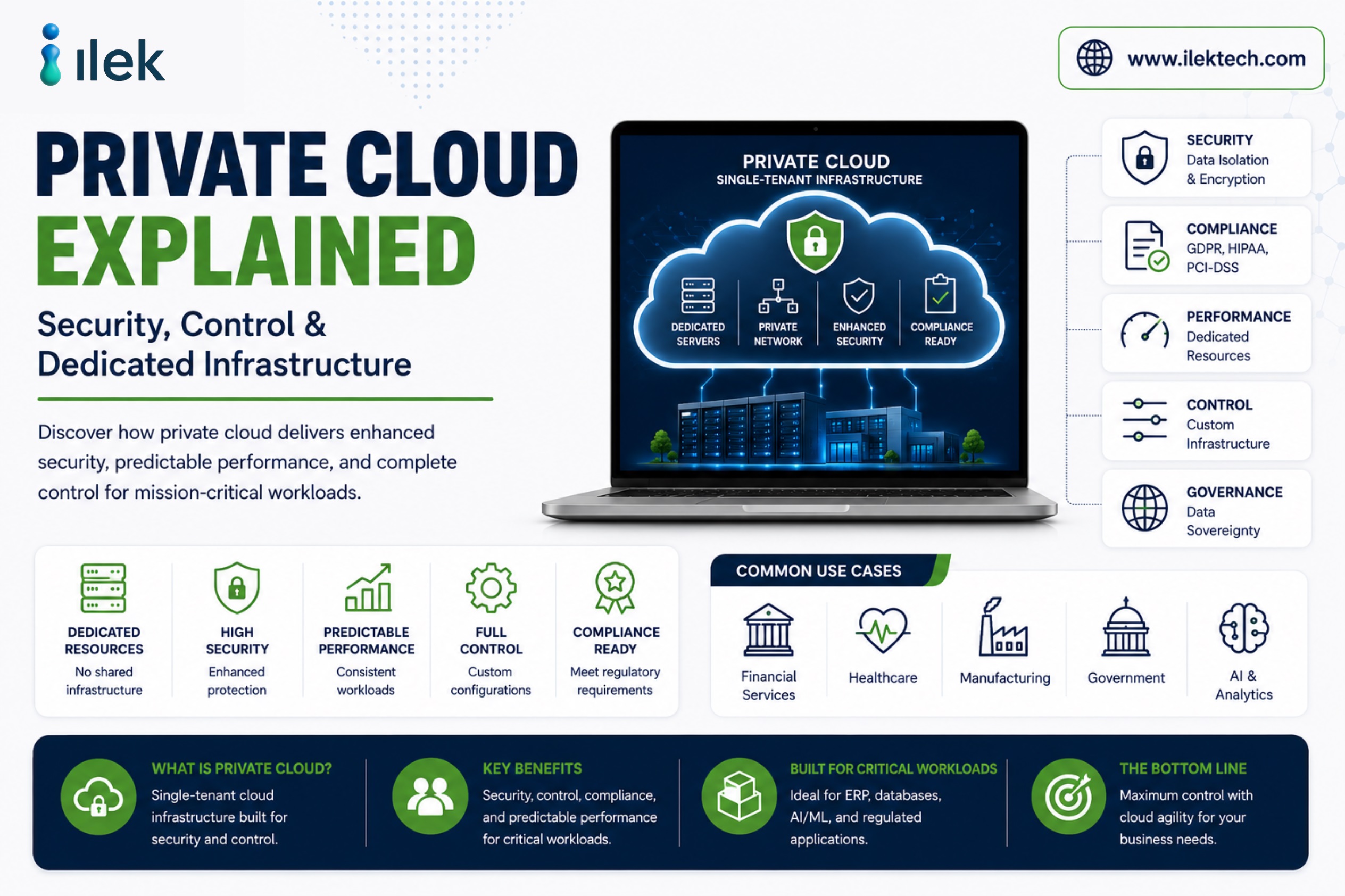
At its core, a private cloud is a cloud computing model where the entire underlying infrastructure, including hardware and software, is provisioned and dedicated exclusively to a single organization. The defining characteristic here is "single-tenancy." Unlike a public cloud, where multiple customers share the same physical server and network resources, a private environment guarantees that an organization's workloads operate on isolated hardware, ensuring unparalleled data privacy and resource allocation.
It is important to differentiate a private cloud from traditional server virtualization. While both use hypervisors to create virtual machines (VMs), a true private cloud elevates this by incorporating a comprehensive management layer that delivers self-service capabilities, automated resource provisioning, and advanced orchestration. This allows users to request and manage computing resources - like virtual servers, storage, and networks - through a portal or API, much like they would in a public cloud, but within a segregated, controlled environment.
Private clouds can be deployed in various models. An on-premise private cloud is hosted within an organization's own data center, giving them full control over every aspect, from physical security to hardware maintenance. Alternatively, a hosted private cloud involves a third-party service provider dedicating physical infrastructure in their data center for exclusive use by a single client, often alleviating the operational burden of managing the physical hardware. For organizations comparing deployment strategies and exploring different cloud models, our guide to public cloud architecture provides additional technical context on shared infrastructure models.
How It Works
The operational framework of a private cloud is predicated on the Software-Defined Data Center (SDDC) paradigm. The SDDC abstracts hardware components - compute, storage, and networking - into software-managed pools, allowing resources to be provisioned, configured, and managed programmatically. This abstraction layer enables the agility and automation characteristic of cloud computing within a dedicated environment.
Architecture
A typical private cloud architecture comprises several interdependent layers, working in concert to deliver a flexible and robust platform:
Physical Hardware Layer: This is the foundation, consisting of bare-metal servers, storage arrays (e.g., SAN, NAS, object storage), and high-speed networking equipment (switches, routers, firewalls). The quality and redundancy of this layer directly impact the private cloud's performance and reliability.
Virtualization Layer (Hypervisor): The hypervisor (e.g., VMware ESXi, KVM, Microsoft Hyper-V) sits directly on the physical hardware. It creates and manages virtual machines (VMs), abstracting the physical CPU, memory, and I/O resources and allocating them dynamically to individual virtual instances.
Software-Defined Networking (SDN): SDN detaches network control from the underlying hardware. This allows administrators to provision and manage network services (e.g., virtual routers, firewalls, load balancers) programmatically, enabling rapid network configuration changes and isolation between virtual segments.
Software-Defined Storage (SDS): SDS decouples storage management from the physical storage hardware. It pools disparate storage devices and presents them as a unified, virtualized resource. This facilitates features like automated tiering, snapshots, and data deduplication, enhancing efficiency and resilience.
Components
Beyond the architectural layers, several key software components are essential for a functioning private cloud:
Orchestration Platform: This is the control plane for the entire private cloud. Platforms like OpenStack, VMware Cloud Foundation, or Red Hat OpenShift coordinate all resource requests, manage the lifecycle of VMs and containers, and automate the deployment of complex application stacks. It provides the APIs through which users and other systems interact with the cloud.
Management Tools: These tools provide administrators with a centralized console to monitor resource utilization, manage user access, enforce policies, and perform maintenance operations across the entire private infrastructure.
Self-Service Portal: This user-friendly interface allows developers and internal teams to provision and de provision resources on demand, adhering to predefined quotas and policies, without requiring direct intervention from IT operations.
Automation Engines: Integrating with tools for Infrastructure as Code (IaC) such as Terraform or Ansible allows for automated deployment and configuration of the private cloud environment itself, from virtual networks to application services.
Workflow
A typical operational workflow within a private cloud environment illustrates its agility:
1. Resource Definition: IT administrators define pools of compute, storage, and network resources. They establish policies for usage, security, and performance.
2. User Request: A developer or application team uses the self-service portal or APIs to request a specific environment-for example, a set of virtual servers with a particular OS, CPU, RAM, and storage configuration, along with specific network access rules.
3. Orchestration and Provisioning: The orchestration platform receives the request. It identifies available resources in the pooled infrastructure, communicates with the hypervisor to spin up the necessary VMs, configures the virtual network via SDN, and allocates storage via SDS.
4. Configuration and Deployment: Automated tools apply necessary configurations, install operating systems, and deploy applications based on predefined templates. This entire process, from request to deployment, can take minutes rather than days.
5. Monitoring and Management: The system continuously monitors the health and performance of all virtual and physical resources. It can automatically scale resources up or down within the defined physical limits, and proactively alert administrators to potential issues or capacity constraints. This proactive approach helps in maintaining the health and efficiency of the private cloud infrastructure.
Benefits of Private Cloud
The strategic advantages of adopting a private cloud are diverse, primarily catering to organizations with specific, non-negotiable requirements:
Superior Security and Data Privacy: The single-tenant nature means physical hardware is dedicated to one organization. This inherently minimizes common multi-tenancy security risks and allows for the implementation of deep, custom security measures at every layer, providing exceptional private cloud security. This level of isolation is often a primary driver for regulated industries.
Strict Regulatory Compliance and Data Sovereignty: For industries bound by strict regulations (e.g., GDPR, HIPAA, PCI-DSS), a private cloud ensures complete control over data location and access. Organizations can guarantee that sensitive data resides within specific geographical borders and adheres to specific hardware certifications and auditing requirements.
Predictable Performance and Latency: Without shared resources, the "noisy neighbor" problem is eliminated. Applications benefit from guaranteed, consistent performance, making private clouds ideal for high-throughput, low-latency workloads like real-time analytics or financial trading platforms.
Tailored Customization: Organizations can select and configure hardware to their exact specifications, incorporating specialized components such as high-performance GPUs, FPGAs, or specific storage types that may not be readily available in standard public cloud offerings.
Cost Optimization for Stable Workloads: While the initial CapEx is higher, for large-scale, consistent, and predictable workloads, a private cloud can prove more cost-effective over the long term, avoiding the variable operational costs associated with public cloud data egress and compute charges.
Enhanced Control and Governance: Full control over the entire infrastructure stack allows IT teams to implement bespoke governance policies, update cycles, and disaster recovery strategies that align perfectly with business needs. This level of control extends to the physical layer, offering unparalleled oversight.
Real-World Use Cases
The versatility and robust nature of private clouds make them suitable for a variety of critical real-world applications across diverse sectors:
Financial Services: Banks and investment firms frequently utilize private clouds to host their core banking applications, trading platforms, and sensitive customer data. This ensures compliance with stringent financial regulations and provides the low-latency performance essential for high-frequency transactions.
Healthcare and Pharmaceutical Research: Handling protected health information (PHI) and conducting advanced medical research requires absolute data privacy and compliance with regulations like HIPAA. Private clouds offer the isolated environments necessary to process and store this sensitive data securely.
Government and Public Sector: National security agencies and government bodies often deploy private clouds to manage classified information and critical public services, where data sovereignty and physical isolation are paramount.
Manufacturing and Industrial Automation: In smart factories and industrial facilities, private clouds form the backbone of edge computing initiatives. They process vast amounts of data from IoT sensors and operational technology (OT) in real-time on-site, enabling immediate responses to production anomalies and minimizing latency for critical processes.
Large-Scale Enterprise Resource Planning (ERP): Many large enterprises host their ERP systems (e.g., SAP, Oracle E-Business Suite) on private clouds. These systems often have complex dependencies, high resource demands, and critical data, making the controlled environment of a private cloud ideal.
Cloud-Native Development and DevOps: For teams building complex cloud-native applications, a private cloud provides a consistent, dedicated environment for development, testing, and staging. This ensures that the production environment is mirrored closely, preventing unexpected issues during deployment and supporting agile DevOps pipelines. The capabilities of an event-driven architecture can further enhance these systems.
Big Data Analytics and AI Training: Organizations dealing with petabytes of proprietary data for AI model training or large-scale analytics benefit from private clouds. They can dedicate high-performance computing (HPC) resources, including specialized GPUs, ensuring data privacy during intensive processing tasks.
Challenges and Limitations
Despite their compelling advantages, private clouds come with inherent challenges that require careful planning and considerable investment:
Significant Initial Capital Expenditure (CapEx): Establishing an on-premises private cloud involves substantial upfront costs for physical servers, storage, networking equipment, data center space, cooling systems, and power infrastructure. This contrasts sharply with the operational expenditure (OpEx) model of public clouds, where costs are typically paid as a service.
Increased Operational Burden: The entire operational responsibility - from hardware maintenance and upgrades to hypervisor patching, network configuration, and physical security - falls squarely on the internal IT team. This
demands a highly skilled workforce and robust operational procedures, which can be a significant staffing and budget consideration.
Scalability Limitations: While private clouds offer elasticity through virtualization, their scalability is ultimately bound by the physical limits of the underlying hardware. Expanding capacity often means procuring, installing, and configuring new servers, which can be a time-consuming process compared to the instantaneous scaling of public cloud resources.
Risk of Underutilization: If a private cloud is over-provisioned to meet infrequent peak demands, idle resources can lead to inefficient use of expensive hardware, driving up the total cost of ownership (TCO). Precise capacity planning is essential to mitigate this.
Obsolescence: Hardware components in a private cloud can become technologically outdated faster than a public cloud provider can refresh its infrastructure, requiring periodic, costly upgrades and strategic lifecycle management.
Complexity of Management: Building and maintaining the full stack - from virtualization to orchestration and automation - can be highly complex, requiring specialized expertise in multiple domains such as networking, storage, compute, and security.
Best Practices
To maximize the return on investment and ensure the long-term success of a private cloud, adhering to a set of best practices is crucial:
1. Strategic Capacity Planning: Conduct thorough analysis of current and projected workloads. Implement robust monitoring to understand resource consumption patterns and right-size your infrastructure to avoid both underutilization and premature capacity bottlenecks. Regularly review and adjust capacity based on actual usage.
2. Embrace Infrastructure as Code (IaC): Treat your private cloud configuration like software. Use tools like Ansible, Puppet, Chef, or Terraform to define and manage your virtual networks, storage volumes, and VM templates. This ensures consistency, repeatability, and version control, significantly reducing manual errors and accelerating deployments.
3. Automate Everything Possible: Automate provisioning, scaling, patching, and decommissioning of resources. Leverage orchestration platforms and scripting to minimize manual intervention, improve efficiency, and reduce operational overhead. This is a key differentiator from traditional virtualized environments.
4. Implement Comprehensive Monitoring and Alerting: Deploy advanced monitoring solutions that cover both the physical hardware layer (temperatures, power, disk health) and the virtualized layer (VM performance, network utilization, application metrics). Proactive alerting is critical for maintaining uptime and performance and for swiftly identifying potential issues within the private cloud.
5. Design for Resiliency and Disaster Recovery: Build redundancy at every layer - compute, storage, and networking - to prevent single points of failure. Implement robust backup and disaster recovery strategies, including off-site backups or hybrid cloud recovery options, to protect against localized failures and ensure business continuity.
6. Prioritize Security from Day One: Integrate security into every aspect of your private cloud design and operation. This includes robust network segmentation, strict access controls, regular security audits, vulnerability scanning, and timely patching of all software components. Remember that in a private cloud, security is entirely your responsibility, unlike in public cloud where it is a shared responsibility model.
7. Plan for Hybrid Cloud Integration: Even if starting with a pure private model, design your architecture with open standards and APIs that facilitate future integration with public cloud services. This allows for "cloud bursting" for temporary peak loads or leveraging specialized public cloud services without vendor lock-in.
Future Trends
The evolution of private cloud technology is driven by the growing demands for specialized workloads, enhanced automation, and seamless integration with emerging technologies:
Hyper-converged Infrastructure (HCI) Domination: HCI solutions, which integrate compute, storage, and networking into a single software-defined appliance, will continue to simplify private cloud deployment and management. They offer a "building block" approach to scaling that mirrors public cloud elasticity on-premise, making private cloud more accessible.
Edge Computing Integration: As IoT devices proliferate, small-footprint private clouds deployed at the network edge will become commonplace. These "edge clouds" will process data closer to its source, enabling ultra-low latency responses critical for industrial automation, smart cities, and autonomous vehicles. This trend directly supports the need for distributed processing power.
Private AI/ML Clouds: The demand for secure and compliant AI model training environments is spurring the development of specialized private clouds. These will feature high-density GPU clusters and specialized software stacks, allowing organizations to develop and deploy advanced AI models using sensitive data without public exposure, safeguarding intellectual property.
Increased Containerization and Serverless Adoption: Kubernetes and other container orchestration platforms are already foundational to many private clouds. The adoption of serverless functions within private environments will further abstract infrastructure, offering developers greater agility and operational efficiency for event-driven workloads, pushing the boundaries of what is possible in a dedicated environment.
Advanced Multi-Cloud and Hybrid Management Platforms: Future private clouds will be even more deeply integrated into hybrid and multi-cloud strategies. Advanced management planes will provide a single pane of glass for orchestrating workloads seamlessly across on-premises private clouds and multiple public cloud providers, simplifying complex environments.
Conclusion
The private cloud remains an essential, strategic asset for organizations that demand the highest levels of security, performance, and control over their IT infrastructure. By leveraging dedicated hardware, advanced virtualization, and intelligent orchestration, it enables enterprises to build robust, scalable, and compliant environments that are perfectly aligned with their unique operational and regulatory mandates. While requiring careful planning and a commitment to operational excellence, the benefits of deterministic performance, unparalleled data sovereignty, and complete architectural flexibility make the private cloud an indispensable component of a sophisticated digital strategy.
As the technological landscape continues to evolve, the private environment will not disappear. Instead, it will continue to adapt, integrating with hybrid models and new innovations like AI and edge computing, ensuring its enduring relevance for mission-critical applications across every industry. Understanding and mastering its intricacies is key to architecting resilient and secure digital futures.
Frequently Asked Questions
What is the core difference between a private cloud and traditional virtualization?
While both use virtualization, a private cloud adds a crucial management layer that provides automation, self-service provisioning, and resource pooling, making it operate more like a public cloud but on dedicated infrastructure. Traditional virtualization often requires manual administration per VM and lacks the cloud-like operational model.
Is a hosted private cloud truly private?
Yes. In a hosted private cloud, a third-party provider allocates dedicated physical servers and network equipment solely for your organization's use within their data center. While the physical location is external and the provider handles some maintenance, the resources are not shared with other customers, maintaining single-tenancy and isolation.
What industries benefit most from private clouds?
Industries with strict data privacy and compliance requirements, such as financial services, healthcare, and government, benefit immensely. Also, organizations needing predictable high performance for critical applications (e.g., real-time analytics, high-frequency trading) and those handling large volumes of sensitive data for AI/ML training find private clouds ideal.
Can a private cloud be integrated with public cloud services?
Absolutely. This is known as a hybrid cloud strategy. Organizations often integrate their private clouds with public clouds to achieve "cloud bursting" for temporary peak loads, enhance disaster recovery capabilities, or to leverage specialized public cloud services while keeping core sensitive workloads on their dedicated private infrastructure.
What are the primary operational challenges of managing an on-premises private cloud?
The primary operational challenges include significant capital expenditure, the need for a highly skilled internal IT team for maintenance and patching, managing hardware lifecycle and obsolescence, and accurately forecasting capacity needs to avoid underutilization or resource bottlenecks. All security responsibilities also fall directly on the internal team.