
Introduction
Large Language Models have changed how software applications interact with information. They can summarize documents, answer questions, generate code, analyze text, and perform many other language-based tasks.
However, an LLM does not automatically know everything an organization needs it to know.
A company's internal documentation, product manuals, support tickets, policies, technical specifications, databases, and frequently changing business information may not be available in the model's training data.
This is where Retrieval-Augmented Generation (RAG) becomes important.
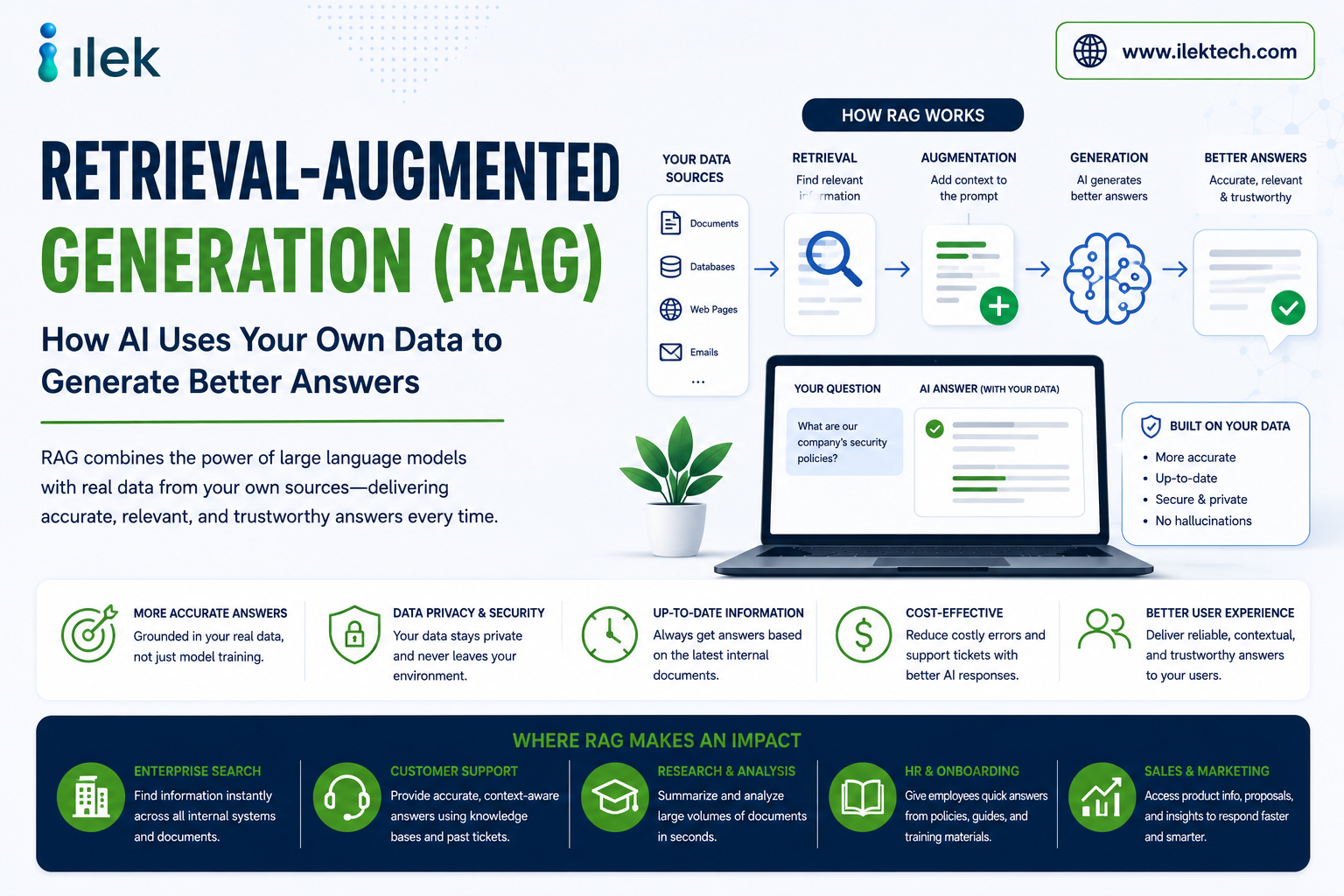
RAG connects a language model with an external knowledge source. Instead of relying entirely on information encoded during model training, the application retrieves relevant information at query time and provides that information to the LLM as context.
The result is an AI system that can answer questions using a specific and controlled knowledge base.
RAG is now widely used as an architecture for building AI assistants, enterprise search systems, document question-answering applications, support systems, and other knowledge-intensive applications.
What Is Retrieval-Augmented Generation?
Retrieval-Augmented Generation is an AI architecture that combines information retrieval with language-model generation.
The basic process is:
User Question → Retrieve Relevant Information → Provide Context to LLM → Generate Answer
For example, imagine a company has thousands of internal documents.
A traditional LLM may not know the company's:
- Internal policies
- Product documentation
- Employee guidelines
- Technical manuals
- Customer support procedures
- Internal architecture documentation
With RAG, these documents can be indexed and searched when a user asks a question.
Suppose an employee asks:
"What is our procedure for requesting production database access?"
The RAG application searches the company's knowledge base, finds the relevant security policy, and passes the relevant sections to the language model.
The LLM then generates an answer based on that retrieved information.
This makes RAG particularly useful when applications need to work with private, domain-specific, or frequently changing information.
Why Do We Need RAG?
Large Language Models have several practical limitations.
Knowledge Limitations
A model's built-in knowledge does not automatically contain your organization's private information.
For example, an LLM cannot inherently know:
"What is the current internal deployment process at Company X?"
unless that information is provided to it.
Knowledge Changes
Business information changes continuously.
Product documentation, pricing, policies, technical specifications, and procedures can change without requiring a new model to be trained.
RAG allows the application to retrieve the latest available information from an external knowledge source.
Hallucinations
LLMs can sometimes generate information that sounds convincing but is unsupported.
RAG attempts to reduce this problem by providing relevant source material as context. However, it is important to understand that RAG does not eliminate hallucinations. The quality of the final answer depends heavily on retrieval quality and how faithfully the model uses the retrieved context. Evaluation therefore needs to consider retrieval and generation separately.
How Does RAG Work?
A RAG system generally contains two major stages:
- Knowledge ingestion and indexing
- Query-time retrieval and generation
A production system can be much more sophisticated, but this basic separation makes the architecture easier to understand.
RAG Architecture
A simplified RAG architecture looks like this:
                KNOWLEDGE SOURCES
                       │
        ┌──────────────┼──────────────┐
        │              │              │
      PDFs          Websites       Databases
        │              │              │
        └──────────────┼──────────────┘
                       ↓
                Document Processing
                       ↓
                    Chunking
                       ↓
                   Embeddings
                       ↓
                Vector / Search Index
                       │
                       │
         User Question ──→ Query Processing
                       ↓
                    Retrieval
                       ↓
                 Reranking
                       ↓
              Relevant Context
                       ↓
                      LLM
                       ↓
                Generated Answer
The important point is that the LLM is only one part of the system.
The retrieval layer determines what information the model gets to see.
RAG Components
1. Data Sources
The first component is the organization's knowledge.
This could include:
- PDF documents
- Word documents
- Websites
- Product documentation
- Database records
- Knowledge bases
- Support tickets
- Internal wikis
- Technical manuals
- API documentation
The source does not necessarily need to be a vector database. Retrieval can also involve structured databases, search indexes, or other retrieval mechanisms depending on the application.
2. Document Processing
Raw documents are rarely ready to be sent directly to an LLM.
The system may need to:
- Extract text
- Remove unnecessary content
- Preserve document structure
- Extract metadata
- Normalize formatting
- Process tables
- Handle different file types
For example, a PDF containing:
| Product Documentation ↓ Installation ↓ Configuration ↓ Troubleshooting |
should ideally retain this structure during processing.
Poor document extraction can result in poor retrieval later.
3. Chunking
Large documents are normally divided into smaller sections called chunks.
For example:
| 100-page PDF ↓ Document processing ↓ Sections ↓ Chunks ↓ Embeddings |
The goal is to create pieces of information that are small enough for efficient retrieval but large enough to preserve useful context.
Chunking is one of the most important design decisions in RAG.
A chunk that is too small may lose context.
A chunk that is too large may contain unrelated information and consume unnecessary context-window capacity.
Modern production RAG systems commonly use structure-aware chunking rather than blindly splitting text at fixed character counts.
4. Embeddings
Once documents are divided into chunks, each chunk can be converted into a numerical representation called an embedding.
For example:
| "How do I reset my account password?" ↓ Embedding Model ↓ [0.021, -0.182, 0.493, ...] |
The embedding represents the semantic characteristics of the text.
This allows the system to compare the meaning of a user's query with the meaning of stored documents.
For example:
Query:
"How can I recover my account?"
might retrieve a document containing:
"Steps for resetting a forgotten password"
even though the wording is different.
This is one of the major differences between semantic retrieval and simple keyword matching.
5. Vector Database
Embeddings need to be stored somewhere so they can be searched efficiently.
This is where vector databases or vector indexes come into the architecture.
A vector database stores embeddings along with associated information such as:
- Document ID
- Original text
- Metadata
- Source
- Timestamp
- Access permissions
When a user submits a query, the query is converted into an embedding and compared against stored vectors.
The system then retrieves the most relevant chunks.
6. Retrieval
Retrieval is the stage where the application searches its knowledge base.
Suppose the user asks:
"What are the backup retention requirements?"
The retrieval system searches the indexed content and may return:
| Result 1: Database Backup Policy Result 2: Disaster Recovery Guidelines Result 3: Data Retention Standards |
The system then passes the most relevant results to the next stage.
7. Reranking
Initial retrieval does not always produce the perfect ordering.
A reranker can evaluate the retrieved candidates again and determine which pieces are most relevant to the specific query.
A simplified pipeline becomes:
| Query ↓ Initial Retrieval ↓ Top 20 Results ↓ Reranker ↓ Top 5 Relevant Results ↓ LLM |
This can improve retrieval quality, particularly when the knowledge base is large or when semantic similarity alone is insufficient.
Hybrid retrieval-combining semantic search with keyword-based approaches - is also increasingly used because exact terms can matter alongside semantic similarity.
8. Context Assembly
The retrieved information is then placed into the LLM's context.
Conceptually:
| System Instructions + User Question + Retrieved Documents ↓ LLM ↓ Answer |
The prompt may instruct the model to answer using only the supplied context and to indicate when sufficient information is unavailable.
This step is important because retrieval alone does not guarantee a correct response.
9. Generation
Finally, the LLM generates the response.
For example:
User:
What is the database backup retention policy?
Retrieved context:
Production database backups are retained for 30 days.
Generated response:
Production database backups are retained for 30 days according to the backup policy.
The language model provides the natural-language interface, while the retrieval system supplies the supporting knowledge.
RAG vs Traditional LLM Applications
Feature | Traditional LLM | RAG |
| External knowledge | Limited | Supported |
| Private company data | Not automatically available | Can be connected |
| Frequently changing information | Difficult | Easier to update |
| Document search | Limited | Core capability |
| Vector database | Not required | Commonly used |
| Retrieval | No | Yes |
| Domain-specific knowledge | Limited by provided context | Stronger |
| Knowledge updates | Usually model-dependent | Update knowledge source |
| Source grounding | Not inherent | Can be implemented |
RAG does not replace an LLM. Instead, it adds a retrieval layer around the model.
RAG vs Fine-Tuning
One of the most common architectural questions is whether to use RAG or fine-tuning.
Requirement | RAG | Fine-Tuning |
| Add changing knowledge | Excellent | Poor fit |
| Private documents | Excellent | Possible |
| Change response style | Limited | Excellent |
| Teach domain-specific behavior | Good | Excellent |
| Update information frequently | Easy | Expensive |
| Source citations | Easier | Not inherent |
| Knowledge retrieval | Yes | No |
| Model behavior customization | Limited | Strong |
RAG is generally useful when the main requirement is giving an existing model access to external knowledge.
Fine-tuning is more appropriate when the goal is to modify model behavior, style, or task-specific capabilities.
In some applications, both approaches can be combined.
Real-World RAG Use Cases
Enterprise Knowledge Assistants
Employees can ask questions about:
- Policies
- Documentation
- Processes
- Procedures
- Internal systems
Customer Support
RAG can retrieve information from:
- Product manuals
- FAQs
- Troubleshooting guides
- Knowledge bases
- Support documentation
The LLM then converts the retrieved information into a conversational response.
Technical Documentation
Developers can ask:
How do I configure this API endpoint?
The system retrieves the relevant documentation and generates an explanation.
Legal and Compliance Research
Organizations can build systems that retrieve relevant policies, regulations, contracts, and internal compliance documentation.
Such systems still require appropriate human review because retrieval does not guarantee legal correctness.
Healthcare Knowledge Systems
RAG can retrieve information from medical documents, research databases, clinical guidelines, and internal documentation.
Because these applications can be high-stakes, retrieval quality, source traceability, access control, and human oversight become especially important.
Common RAG Challenges
Building a demonstration RAG system is relatively straightforward.
Building a reliable production system is much harder.
Poor Chunking
If important information is split incorrectly, retrieval may fail.
Irrelevant Retrieval
The system may retrieve documents that are semantically similar but do not actually answer the question.
Missing Information
If the required information is not present in the knowledge base, the system cannot retrieve it.
Hallucination
Even with relevant context, the LLM can generate unsupported information.
Context Limits
Sending too many retrieved documents can consume the model's context window and introduce irrelevant information.
Latency
A production RAG request may involve:
| Query ↓ Embedding ↓ Search ↓ Reranking ↓ Prompt Construction ↓ LLM ↓ Response |
Each stage adds processing time.
Security
Enterprise RAG systems must also consider authorization.
A user should not receive information simply because the retrieval engine found it.
For example:
| User A ↓ Query ↓ Permission Filter ↓ Allowed Documents ↓ Retrieval |
Access control should therefore be part of the architecture rather than added as an afterthought.
Best Practices for Building RAG Systems
Start With Data Quality
Good retrieval starts with clean, structured, well-maintained source data.
Choose Chunking Carefully
Consider document structure, headings, paragraphs, tables, and semantic boundaries rather than relying only on fixed-size chunks.
Store Metadata
Useful metadata can include:
- Document type
- Department
- Author
- Version
- Date
- Access level
- Source URL
Metadata can then be used to filter retrieval.
Consider Hybrid Search
Combining semantic retrieval with keyword-based search can be useful when exact terms, product names, identifiers, or technical terminology matter.
Add Reranking When Necessary
For larger or more complex knowledge bases, reranking can improve the quality of the final context.
Evaluate Retrieval Separately
Do not evaluate only the final answer.
Measure whether the system actually retrieved the correct information.
Useful evaluation dimensions include:
- Context precision
- Context recall
- Answer relevance
- Faithfulness
These dimensions are commonly used in RAG evaluation frameworks.
Monitor the Complete Pipeline
Production monitoring should consider:
| Retrieval quality + Latency + Token usage + Generation quality + Failure rate + Security |
The Future of RAG
RAG itself is evolving beyond basic vector search.
Emerging approaches include:
- Hybrid retrieval
- Reranking
- Multimodal RAG
- Graph-based retrieval
- Agentic retrieval
- Self-correcting retrieval
- Hierarchical retrieval
- Structured-data retrieval
Modern research is also exploring architectures that combine vector retrieval with structured navigation and reasoning to improve evidence localization in complex datasets.
This means future RAG systems will increasingly behave less like a simple document search engine and more like intelligent information-retrieval systems capable of determining what information to retrieve, where to retrieve it from, and how much context is actually required.
Conclusion
Retrieval-Augmented Generation is an important architecture for connecting Large Language Models with external knowledge.
Instead of expecting an LLM to contain every piece of information an application needs, RAG provides a mechanism for retrieving relevant information at query time and using that information as context for generation.
A reliable RAG system requires much more than a vector database. Document processing, chunking, embeddings, retrieval, ranking, context construction, generation, evaluation, security, and monitoring all contribute to the final result.
For developers building AI applications, understanding these components is essential. A well-designed RAG pipeline can turn a general-purpose language model into a domain-aware application capable of working with organizational documents, technical knowledge, product information, and other external data sources.
The key lesson is simple: better retrieval leads to better context, and better context gives the language model a stronger foundation for generating useful answers.
Frequently Asked Questions
What is RAG in AI?
RAG, or Retrieval-Augmented Generation, is an architecture that retrieves relevant information from external sources and provides it to a language model as context before generating a response.
Does RAG eliminate AI hallucinations?
No. RAG can reduce the risk of unsupported answers by providing relevant source material, but it does not guarantee factual accuracy. Retrieval and generation quality must both be evaluated.
Does RAG require a vector database?
No. Vector databases are common in RAG systems, but retrieval can also use traditional keyword search, databases, search indexes, hybrid approaches, or other retrieval mechanisms depending on the application.
What is the difference between RAG and fine-tuning?
RAG provides external information to a model at query time, while fine-tuning changes the model's learned behavior through additional training. RAG is generally better suited to frequently changing knowledge.
What are the main components of a RAG system?
A typical RAG system includes data ingestion, document processing, chunking, embeddings, indexing, retrieval, optional reranking, context assembly, an LLM, and an evaluation process.