

Introduction
Modern AI applications rarely need to build a model entirely from scratch.
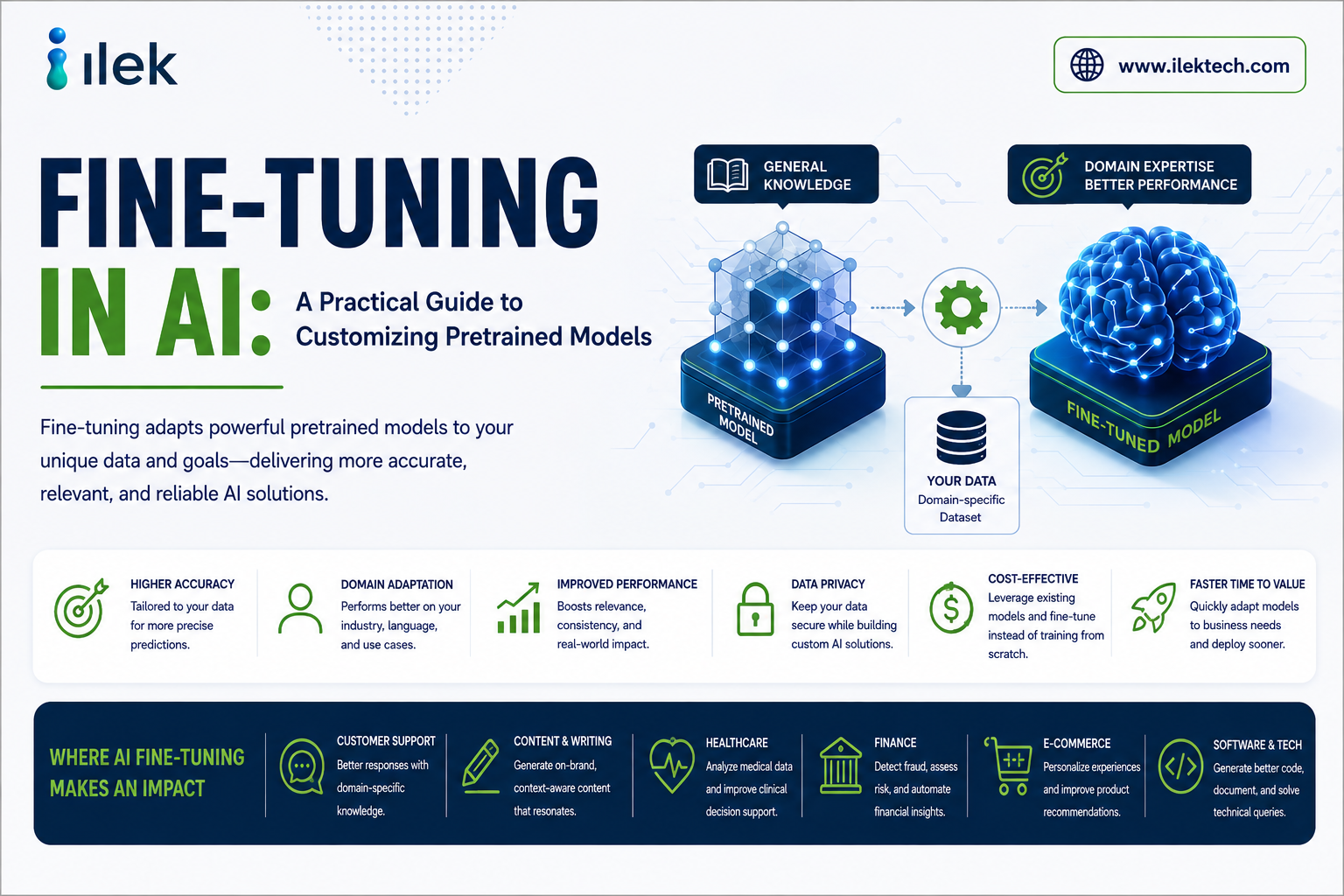
Instead, developers can start with a pretrained AI model and adapt it for a specific task, industry, or style. This process is known as fine-tuning.
Fine-tuning is particularly useful when a general-purpose model performs reasonably well but does not consistently produce the behavior required by a specific application.
For example, a general language model may understand programming concepts, but a company might want a model that follows its internal documentation style, understands specialized terminology, or consistently produces a particular output format.
Rather than training an entirely new model, fine-tuning allows developers to take an existing pretrained model and continue training it using a carefully prepared dataset.
This makes fine-tuning an important technique in modern machine learning and generative AI development.
What Is Fine-Tuning?
Fine-tuning is the process of taking a pretrained machine learning model and training it further on a smaller, task-specific dataset.
A pretrained model has already learned general patterns from a large training dataset.
Fine-tuning modifies some or all of the model's parameters so that it becomes better suited to a particular task.
The basic process looks like this:
Pretrained Model → Specialized Dataset → Additional Training → Customized Model
For example:
| General Language Model ↓ Customer Support Dataset ↓ Fine-Tuning ↓ Customer Support Model |
The resulting model is not necessarily a completely new AI system. Instead, it is a specialized version of an existing model.
This distinction is important because training a large model from scratch can require enormous amounts of data, computing resources, engineering expertise, and time.
Fine-tuning starts with knowledge that the model has already acquired.
How Fine-Tuning Works
Fine-tuning builds on the original training process of a machine learning model.
During initial training, a model learns general patterns from a very large dataset.
For a language model, this may include:
- Language structure
- Grammar
- Programming concepts
- General knowledge
- Relationships between words
- Patterns in text
- Reasoning patterns
Fine-tuning introduces another dataset containing examples that represent the desired behavior.
For example, consider a customer-support application.
The training dataset could contain:
| User Input | Desired Response |
| How do I reset my password? | Follow these steps to reset your password... |
| How can I update my email? | You can update your email from... |
| My account is locked. | Your account can be unlocked by... |
The model learns patterns from these examples and adjusts its parameters to produce responses that better match the desired behavior.
Training Process
A simplified fine-tuning workflow looks like this:
| Collect Training Data ↓ Clean and Prepare Dataset ↓ Choose Pretrained Model ↓ Configure Fine-Tuning ↓ Train Model ↓ Evaluate Results ↓ Deploy Model ↓ Monitor Performance |
The quality of each stage affects the final result.
A poorly prepared dataset can produce a poorly specialized model even when the underlying pretrained model is highly capable.
Fine-Tuning vs Training From Scratch
One of the most important decisions in AI development is determining whether a model should be trained from scratch or fine-tuned.
| Factor | Training From Scratch | Fine-Tuning |
| Starting point | Randomly initialized model | Pretrained model |
| Data requirement | Extremely high | Usually much lower |
| Computing requirement | Very high | Lower |
| Development complexity | Very high | Moderate |
| Training time | Long | Shorter |
| Cost | Very high | Generally lower |
| General knowledge | Must be learned | Already available |
| Customization | Very high | High |
| Typical use | Foundation models | Specialized applications |
For most application-level AI projects, fine-tuning is considerably more practical than training an entire model from scratch.
Types of Fine-Tuning
Fine-tuning is not a single technique. Different approaches can be used depending on the model, dataset, hardware, and desired outcome.
Full Fine-Tuning
In full fine-tuning, the model's parameters are updated during training.
This provides significant customization but can require substantial computational resources.
Full fine-tuning is generally more suitable when:
- Large training datasets are available
- Significant model behavior changes are required
- Adequate GPU infrastructure is available
- The organization can manage model training and deployment
However, it may be unnecessary for many smaller projects.
Parameter-Efficient Fine-Tuning
Parameter-efficient fine-tuning, often called PEFT, aims to customize a model without updating every parameter.
Instead, only a smaller portion of the model is modified.
This can substantially reduce memory and computational requirements.
Common approaches include:
- LoRA
- Adapter-based methods
- Prefix tuning
- Prompt tuning
These techniques have become particularly useful for adapting large language models.
What Is LoRA Fine-Tuning?
LoRA, or Low-Rank Adaptation, is a parameter-efficient fine-tuning technique.
Instead of modifying the entire model, LoRA introduces smaller trainable components into selected parts of the network.
The original model remains largely unchanged while the additional parameters learn the task-specific behavior.
Conceptually:
| Original Model + Small Trainable LoRA Layers ↓ Specialized Model |
One advantage is that the resulting adaptation can be considerably smaller than a complete copy of the model's updated parameters.
This makes LoRA particularly useful when organizations want to create multiple specialized versions of the same base model.
For example:
| Base Model ├── Customer Support Adapter ├── Technical Documentation Adapter ├── Legal Language Adapter └── Marketing Writing Adapter |
The same base model can therefore support multiple specialized behaviors.
Fine-Tuning vs Prompt Engineering
Fine-tuning and prompt engineering solve related but different problems.
Prompt engineering changes the instructions given to the model.
Fine-tuning changes the model's learned behavior through additional training.
| Prompt Engineering | Fine-Tuning |
| Changes instructions | Changes model parameters |
| No model training required | Requires training |
| Faster to implement | Requires training pipeline |
| Easy to modify | Requires retraining for major changes |
| Good for task instructions | Good for consistent behavior |
| Lower infrastructure requirements | Higher infrastructure requirements |
For example, if you want an AI model to answer in JSON format, prompt engineering may be sufficient.
However, if you need the model to consistently follow a specialized response style across thousands of requests, fine-tuning may be worth considering.
In many systems, the two approaches are used together.
Fine-Tuning vs RAG
Fine-tuning is also frequently confused with Retrieval-Augmented Generation (RAG).
They solve different problems.
| Fine-Tuning | RAG |
| Changes model behavior | Provides external information |
| Uses training data | Uses retrieved documents |
| Knowledge becomes part of model behavior | Knowledge remains outside the model |
| Requires training | Usually does not require model training |
| Useful for style and behavior | Useful for current or private information |
| Updating knowledge may require retraining | Documents can be updated independently |
For example, suppose a company has thousands of internal documents.
If the goal is to allow an AI assistant to answer questions using those documents, RAG may be more appropriate.
If the goal is to make the model consistently respond according to a specific format or behavior, fine-tuning may be more suitable.
In some systems, both approaches can be combined.
Preparing Data for Fine-Tuning
Training data is one of the most important parts of a successful fine-tuning project.
A common mistake is assuming that a larger dataset automatically produces a better model.
The quality, consistency, and relevance of the dataset are often more important than simply increasing the number of examples.
Data Quality
Training examples should be:
- Accurate
- Relevant
- Consistent
- Representative of real usage
- Free from unnecessary duplication
- Properly formatted
Consider a customer-support model.
If some training examples contain formal responses while others contain informal or contradictory answers, the model may learn inconsistent behavior.
Dataset Size
The required dataset size depends heavily on the task.
A simple formatting or classification task may require relatively few high-quality examples.
More complex behavioral changes may require significantly more data.
There is no universal dataset size that guarantees good results.
Training and Validation Data
The dataset should normally be separated into training and evaluation portions.
For example:
| Complete Dataset ↓ ┌───────────────┐ │ Training Data │ └───────────────┘ + ┌────────────────┐ │ Validation Data │ └────────────────┘ |
The model should be evaluated using examples that were not directly used during training.
This helps identify overfitting.
Overfitting in Fine-Tuning
Overfitting occurs when a model becomes too specialized to the training examples and performs poorly on new inputs.
For example, imagine training a model using only a small number of customer questions.
The model might perform extremely well on those exact questions but fail when users phrase the same requests differently.
A well-designed fine-tuning process should therefore test generalization.
Instead of evaluating:
"How do I reset my password?"
only, also test variations such as:
"I forgot my login password. How can I recover it?"
The goal is not for the model to memorize the training examples.
The goal is for it to learn the underlying behavior.
Real-World Use Cases
Fine-tuning can be useful across many industries and applications.
Customer Support
Organizations can fine-tune models to follow a consistent support style and response structure.
Code Generation
Specialized models can be adapted for particular programming languages, frameworks, coding conventions, or internal development patterns.
Document Processing
Fine-tuning can help models consistently extract information from specialized document formats.
Healthcare
Models can be adapted to understand domain-specific terminology and workflows, although additional validation and safety controls are essential.
Financial Applications
Financial organizations may use specialized models for classification, document analysis, or domain-specific language processing.
Enterprise Assistants
Organizations can customize models to follow internal communication patterns, formatting requirements, or specialized workflows.
Content Generation
Fine-tuning can help maintain a consistent writing style across large volumes of generated content.
Challenges and Limitations
Fine-tuning provides powerful customization, but it is not always the best solution.
Data Preparation
Preparing a high-quality dataset can require significant manual effort.
Poor data can produce poor model behavior.
Computational Cost
Even parameter-efficient techniques require computational resources.
Larger models generally require more memory and processing power.
Model Drift
Fine-tuned behavior may become less effective when the underlying business requirements change.
Regular evaluation is therefore important.
Catastrophic Forgetting
Aggressive fine-tuning can sometimes cause a model to lose some capabilities learned during its original training.
This is one reason training configuration and dataset design matter.
Evaluation Difficulty
It can be difficult to determine whether a fine-tuned model is actually better than the original model.
Evaluation should use clearly defined metrics and realistic test cases.
Best Practices for Fine-Tuning
Start With the Base Model
Before fine-tuning, test the original model using carefully designed prompts.
Sometimes prompt engineering is enough.
Define the Desired Behavior
Clearly identify what the model needs to do differently.
For example:
- Response format
- Tone
- Classification behavior
- Domain terminology
- Output structure
- Task-specific behavior
Use High-Quality Examples
A small dataset of excellent examples can be more useful than a large dataset containing inconsistent information.
Keep Evaluation Data Separate
Do not evaluate the model only on examples used during training.
Use unseen examples to measure generalization.
Compare Against the Base Model
Always compare the fine-tuned model against the original model.
The objective is not simply to produce a customized model. It is to produce a model that performs better for the intended task.
Monitor Production Performance
Fine-tuning does not eliminate the need for monitoring.
Track:
- Accuracy
- Failure rates
- User feedback
- Latency
- Cost
- Unexpected outputs
Production monitoring can reveal problems that were not visible during offline evaluation.
When Should You Fine-Tune an AI Model?
Fine-tuning is generally worth considering when:
- Prompt engineering is no longer sufficient
- Consistent behavior is required
- You have representative training data
- The task is repeated at significant scale
- Model output needs a specific structure or style
- The organization has the infrastructure to evaluate and maintain the model
Fine-tuning may not be the right choice when the primary problem is access to changing information.
For example, if the model needs current company policies, product documentation, or frequently changing technical information, a retrieval-based architecture may be more appropriate.
The key question should therefore be:
Do we need to change what the model knows, or do we need to change how the model behaves?
That distinction can prevent unnecessary training work.
Fine-Tuning in a Modern AI Architecture
Fine-tuning rarely exists in isolation.
A production AI application may combine several technologies:
User ↓ Application ↓ AI Pipeline ┌────────┴────────┐ ↓ ↓ Fine-Tuned Retrieval Model System ↓ ↓ └────────┬────────┘ ↓ AI Response |
The fine-tuned model can provide specialized behavior while a retrieval system provides current or private information.
Additional components such as APIs, databases, monitoring systems, and workflow automation can then be integrated around the model.
This architecture allows organizations to treat AI as part of a broader software system rather than as an isolated model.
Future of Fine-Tuning
Fine-tuning is likely to remain an important part of AI development as organizations move from experimenting with general-purpose models toward specialized AI systems.
Several trends are particularly important.
Smaller Specialized Models
Organizations may increasingly choose smaller models customized for specific workloads instead of using the largest available model for every task.
Parameter-Efficient Training
Techniques such as LoRA and other PEFT approaches can make model customization more accessible.
Automated Dataset Generation
AI-assisted data generation and data cleaning can reduce some of the manual work involved in creating training datasets.
Domain-Specific AI
More organizations are likely to develop specialized models for areas such as finance, healthcare, manufacturing, software engineering, and customer service.
Combined AI Architectures
Fine-tuning, RAG, tool calling, agents, and traditional software systems will increasingly work together.
The result will be AI applications designed around specific business and technical requirements rather than simply placing a general-purpose chatbot inside an application.
Conclusion
AI fine-tuning provides a practical way to customize pretrained models for specialized tasks without building a foundation model from scratch.
Its biggest value comes from changing model behavior, improving consistency, and adapting general-purpose models to specific requirements.
However, fine-tuning should not automatically be the first solution.
Prompt engineering may be enough for simple behavioral changes, while RAG may be better when the primary requirement is access to changing or private information.
A successful fine-tuning project therefore starts with a clear problem definition, high-quality training data, appropriate training techniques, and rigorous evaluation.
As AI systems become increasingly specialized, understanding when and how to use fine-tuning will become an important skill for developers, architects, and teams building production-grade AI applications.
Frequently Asked Questions
What is fine-tuning in AI?
Fine-tuning is the process of taking a pretrained AI model and training it further using task-specific data so that it performs better for a particular use case.
Is fine-tuning better than prompt engineering?
Not always. Prompt engineering is usually simpler and cheaper. Fine-tuning becomes useful when consistent specialized behavior is required and prompting alone is insufficient.
What is the difference between fine-tuning and RAG?
Fine-tuning changes the model's learned behavior, while RAG provides the model with external information at runtime. They can also be used together.
Does fine-tuning require a large dataset?
Not necessarily. The required amount of data depends on the task and model. High-quality, representative examples are generally more important than simply having a large dataset.
Can a fine-tuned model still use external data?
Yes. A fine-tuned model can be combined with databases, APIs, RAG systems, and other external data sources to create more capable AI applications.
Is fine-tuning expensive?
The cost depends on the model size, training method, dataset, hardware, and number of training iterations. Parameter-efficient techniques can significantly reduce the resources required compared with full fine-tuning.