

Introduction
Artificial Intelligence has transformed how developers write code, businesses automate workflows, and individuals create content. However, one factor determines whether AI delivers mediocre responses or exceptional results: the quality of the prompt.
This has given rise to a rapidly growing discipline known as Prompt Engineering.
Prompt engineering is no longer limited to AI researchers. Software developers, DevOps engineers, technical writers, marketers, business analysts, automation engineers, and students all benefit from learning how to communicate effectively with AI systems.
Whether you're using ChatGPT, Google Gemini, Claude, GitHub Copilot, or integrating Large Language Models (LLMs) into enterprise software, understanding prompt engineering significantly improves accuracy, consistency, and productivity.
This guide explains prompt engineering from first principles, explores common techniques, provides practical examples, discusses limitations, and shares best practices for building reliable AI-powered applications.
What Is Prompt Engineering?
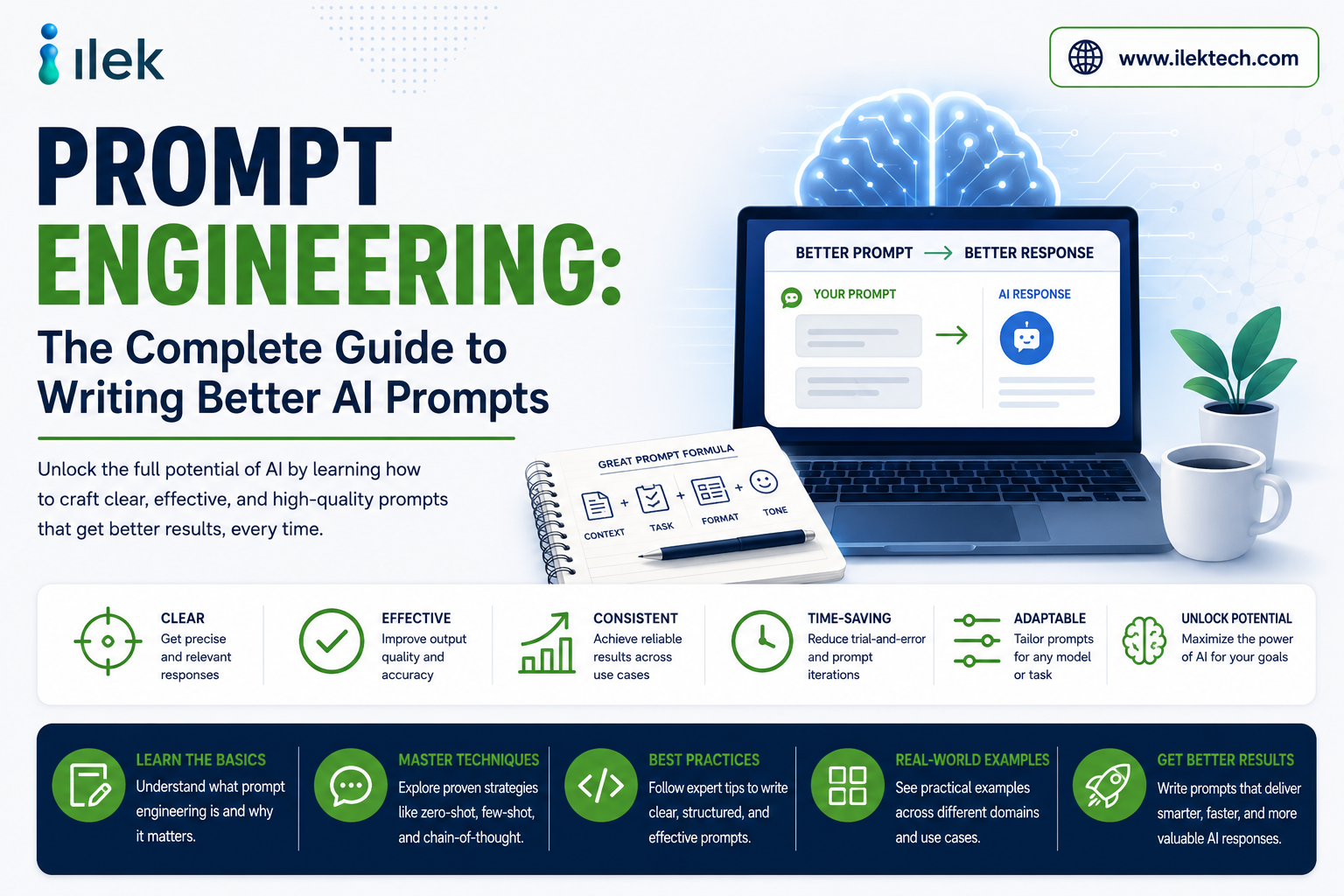
Prompt engineering is the process of designing, structuring, and refining instructions given to an AI model to produce accurate, relevant, and useful outputs.
Instead of simply asking a question, prompt engineering focuses on providing the AI with enough context, constraints, examples, and objectives to guide its reasoning.
Think of it as writing specifications for an intelligent assistant.
A well-written prompt helps the AI understand:
- What problem needs solving
- What output format is expected
- What level of detail is required
- Who the audience is
- What limitations should be followed
The better the prompt, the better the response.
Why Prompt Engineering Matters
Modern AI models generate responses based entirely on the instructions they receive.
Poor prompts often produce:
- Generic answers
- Missing information
- Incorrect assumptions
- Hallucinated facts
- Inconsistent formatting
Well-designed prompts result in:
- Better accuracy
- More consistent outputs
- Higher productivity
- Reduced manual editing
- Improved automation reliability
For businesses implementing AI into products or workflows, prompt engineering directly impacts the quality of customer-facing applications.
How Prompt Engineering Works
Large Language Models predict the most likely sequence of words based on patterns learned during training.
The prompt acts as the context that influences these predictions.
A typical prompt contains several components:
| Component | Purpose |
| Role | Defines who the AI should act as |
| Task | Explains the objective |
| Context | Provides background information |
| Constraints | Defines limitations |
| Output Format | Specifies how results should be returned |
| Examples | Demonstrates expected behavior |
The more structured the prompt, the more predictable the output.
Types of Prompt Engineering
Zero-Shot Prompting
The AI receives only the task without examples.
Example: Explain Kubernetes in simple terms.
Suitable for general knowledge tasks.
One-Shot Prompting
The prompt includes one example before asking the AI to complete a similar task.
This helps improve consistency.
Few-Shot Prompting
Multiple examples teach the model the expected response pattern.
Widely used for:
- Text classification
- Data extraction
- Code generation
- Customer support
Chain-of-Thought Prompting
Instead of requesting only the answer, the prompt encourages logical reasoning.
Useful for:
- Complex calculations
- Technical troubleshooting
- Software architecture decisions
- Multi-step workflows
Role-Based Prompting
Assigning a professional role improves domain-specific responses.
Examples:
- Senior Software Architect
- DevOps Engineer
- Technical Writer
- Cloud Solutions Architect
- Security Consultant
Anatomy of a Good Prompt
An effective prompt typically includes:
Objective: Clearly state what should be accomplished.
Audience: Specify who the response is for.
Context: Provide relevant background.
Constraints: Mention word limits, technologies, tone, or formatting.
Output Format: Request Markdown, HTML, JSON, tables, bullet points, or code.
Example Comparison
Weak Prompt: Write about Kubernetes.
Output: Generic overview with limited depth.
Strong Prompt: You are a cloud architect. Write a beginner-friendly guide explaining Kubernetes architecture for software developers. Include diagrams (described in text), real-world examples, best practices, FAQs, and optimize the article for SEO using HTML headings.
The second prompt produces significantly more useful results.
Prompt Engineering Techniques
| Technique | Best For |
| Zero-shot | Simple tasks |
| Few-shot | Consistent outputs |
| Role prompting | Domain expertise |
| Chain of Thought | Complex reasoning |
| Step-by-step prompting | Multi-stage workflows |
| Output formatting | JSON, HTML, Markdown |
| Context injection | Business-specific tasks |
| Constraint prompting | Better accuracy |
Real-World Applications
Prompt engineering is transforming many industries.
| Industry | Example |
| Software Development | Code generation |
| DevOps | Infrastructure automation |
| Customer Support | AI chatbots |
| Healthcare | Medical documentation |
| Finance | Report generation |
| Education | Personalized learning |
| Marketing | Content creation |
| Manufacturing | Process documentation |
Prompt Engineering in Software Development
Developers increasingly use prompt engineering for:
- Code generation
- Bug fixing
- SQL queries
- API documentation
- Test case creation
- Code reviews
- Unit testing
- Refactoring
- CI/CD automation
When combined with workflow automation with n8n, prompt engineering enables AI-driven business processes that reduce repetitive manual work.
Common Mistakes
Avoid these common prompt engineering mistakes:
| Mistake | Better Alternative |
| Asking vague questions | Define specific objectives |
| Missing context | Explain the background |
| No output format | Request HTML, JSON, or Markdown |
| Too many unrelated tasks | Split into multiple prompts |
| No constraints | Define word count, tone, and audience |
Best Practices
- Be specific.
- Provide context.
- Assign an expert role.
- Define output format.
- Include constraints.
- Break large tasks into smaller prompts.
- Test multiple prompt variations.
- Iterate continuously.
Prompt Engineering for AI Automation
Prompt engineering plays a crucial role in modern automation platforms.
Examples include:
- AI-powered document generation
- Email drafting
- Customer support automation
- Workflow automation with n8n
- AI-based reporting
- Ticket summarization
- Knowledge base generation
As organizations adopt AI-powered SaaS platforms, prompt engineering becomes a core skill for building scalable AI solutions.
Future of Prompt Engineering
Prompt engineering continues to evolve alongside advances in generative AI.
Emerging trends include:
- Multimodal prompting (text, image, audio, and video)
- AI agents with long-term memory
- Autonomous workflow orchestration
- Retrieval-Augmented Generation (RAG)
- Prompt optimization using AI
- Domain-specific prompt libraries
- Agentic AI systems
Although future models will better understand natural language, structured prompting will remain essential for enterprise applications that demand predictable, repeatable, and secure outputs.
Conclusion
Prompt engineering has become one of the most valuable skills in the AI era. Whether you're developing software, automating workflows, creating technical documentation, or building AI-powered products, the quality of your prompts directly influences the quality of your results.
By understanding how Large Language Models interpret instructions and by applying structured prompting techniques, organizations can achieve more accurate responses, reduce manual effort, and build reliable AI-driven systems. As generative AI becomes an integral part of modern software development, prompt engineering will continue to play a central role in maximizing the value of AI technologies.
Frequently Asked Questions
What is prompt engineering?
Prompt engineering is the practice of designing effective instructions that help AI models generate accurate, relevant, and high-quality responses.
Do software developers need prompt engineering?
Yes. Developers use prompt engineering for code generation, debugging, documentation, testing, API design, and AI application development.
Is prompt engineering only for ChatGPT?
No. It applies to all modern Large Language Models, including Google Gemini, Claude, GitHub Copilot, Llama, and enterprise AI systems.
Can prompt engineering improve AI accuracy?
Yes. Well-structured prompts reduce ambiguity, improve consistency, and produce more reliable outputs.
Will prompt engineering remain important in the future?
Yes. While AI models are becoming more capable, enterprise applications will continue to require structured prompts to ensure predictable, secure, and context-aware responses.