
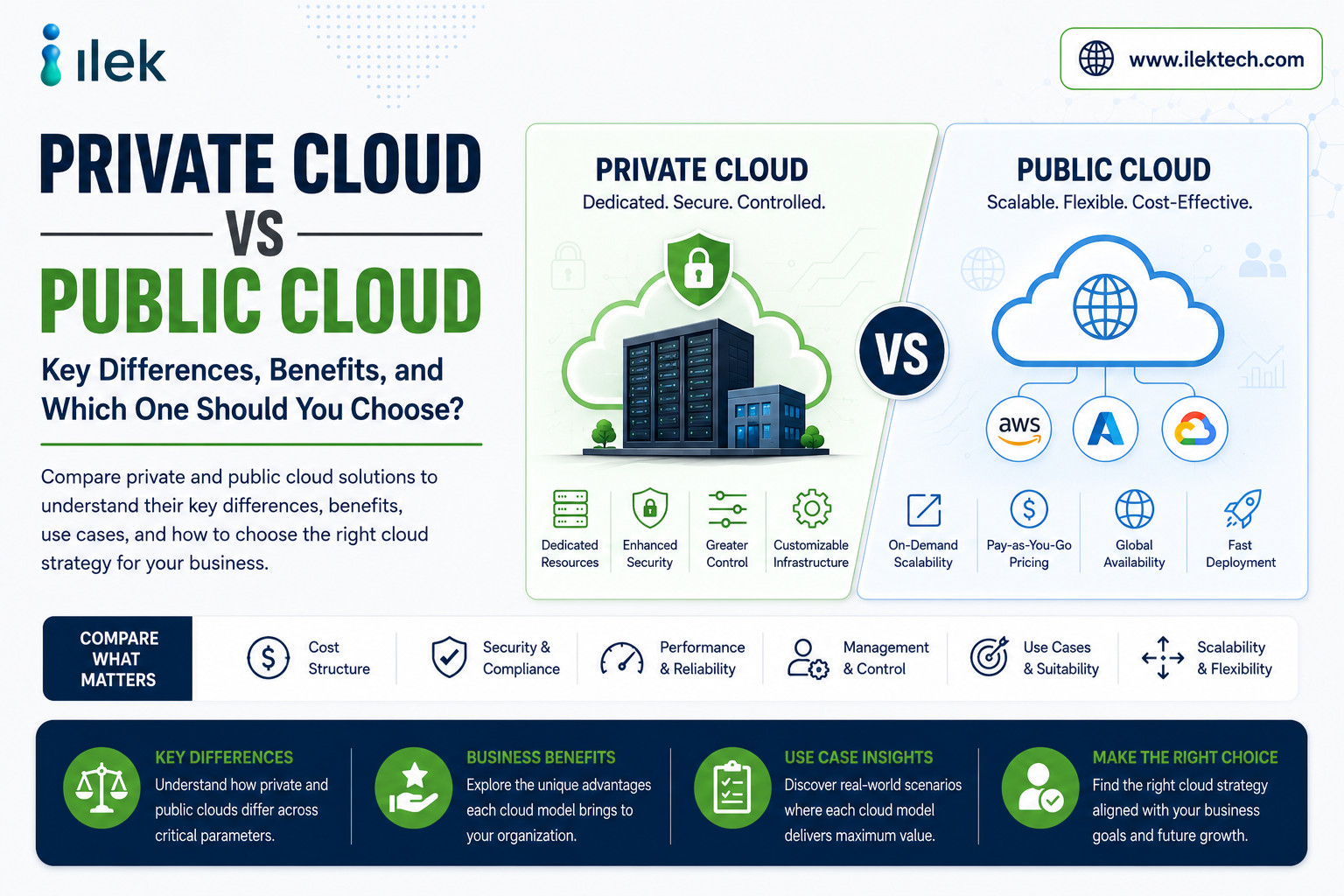
Cloud computing has fundamentally changed how organizations deploy applications, store data, and scale infrastructure. However, one of the most common questions organizations face is whether they should choose a private cloud or a public cloud.
Although both models provide virtualization, automation, and on-demand computing resources, they differ significantly in ownership, architecture, security, performance, compliance, and operational responsibility.
This guide provides a detailed comparison between private cloud and public cloud, helping IT professionals, architects, business owners, and students understand where each model fits best.
What Is a Public Cloud?
A public cloud is a cloud computing model where infrastructure is owned and managed by a cloud provider. Computing resources are shared among multiple customers while remaining logically isolated.
Organizations only pay for the resources they consume, making public cloud highly scalable and cost-efficient.
Typical characteristics include:
- Shared infrastructure
- Pay-as-you-go pricing
- Elastic scalability
- Fully managed hardware
- Global availability
What Is a Private Cloud?
A private cloud provides dedicated cloud infrastructure exclusively for one organization.
The infrastructure may be hosted inside the organization's own data center or managed by a third-party provider, but resources remain isolated and are never shared with other customers.
Private clouds offer greater control, stronger security customization, and predictable performance.
Typical characteristics include:
- Dedicated infrastructure
- Single-tenant architecture
- Custom security policies
- Full infrastructure control
- Enterprise-grade compliance
Private Cloud vs Public Cloud Comparison
| Feature | Private Cloud | Public Cloud |
| Infrastructure Ownership | Single organization | Cloud provider |
| Resource Sharing | Dedicated resources | Shared (Multi-tenant) |
| Deployment Model | On-premises or Hosted | Internet-based |
| Scalability | Limited by hardware | Virtually unlimited |
| Initial Investment | High | Low |
| Operational Cost | Predictable | Usage-based |
| Hardware Management | Customer or Hosting Partner | Cloud Provider |
| Provisioning Speed | Fast | Instant |
| Customization | Extensive | Limited |
| Maintenance | Customer responsibility | Provider responsibility |
| Disaster Recovery | Self-managed | Built-in options |
| Availability | Depends on architecture | Global infrastructure |
Security Comparison
| Security Aspect | Private Cloud | Public Cloud |
| Physical Isolation | Yes | No |
| Data Isolation | Dedicated | Logical isolation |
| Firewall Control | Complete | Limited customization |
| Network Segmentation | Fully customizable | Provider managed |
| Identity Management | Fully controlled | Shared responsibility |
| Security Updates | Customer managed | Provider managed |
| Encryption | Customizable | Built-in |
| Compliance Control | Maximum | Provider-supported |
Winner
If your organization handles highly sensitive information or strict compliance requirements, a private cloud typically provides greater administrative control.
Cost Comparison
| Cost Factor | Private Cloud | Public Cloud |
| Initial Hardware Cost | High | None |
| Monthly Infrastructure Cost | Stable | Variable |
| Maintenance Cost | Higher | Included |
| Hardware Refresh | Required | Provider handles |
| Long-Term Stable Workloads | Cost Effective | May become expensive |
| Small Projects | Less suitable | Excellent |
| Startup Budget | High investment | Low investment |
Winner
Public cloud is generally the better choice for startups, SMEs, and organizations seeking minimal upfront investment.
Performance Comparison
| Performance Factor | Private Cloud | Public Cloud |
| Resource Contention | None | Possible |
| Predictable Performance | Excellent | Good |
| Latency Control | High | Moderate |
| Custom Hardware | Yes | Limited |
| GPU Customization | Complete | Provider options |
| Network Optimization | Full Control | Limited |
Scalability Comparison
| Feature | Private Cloud | Public Cloud |
| Auto Scaling | Limited | Excellent |
| Resource Expansion | Hardware purchase required | Immediate |
| Geographic Expansion | Limited | Global |
| Capacity Planning | Required | Minimal |
Winner
Public cloud offers unmatched scalability for growing businesses.
Compliance Comparison
| Compliance Area | Private Cloud | Public Cloud |
| Data Residency | Complete Control | Depends on Provider |
| Industry Regulations | Easier to Customize | Shared Responsibility |
| Government Workloads | Excellent | Depends |
| Financial Services | Excellent | Good |
| Healthcare | Excellent | Good |
Management Comparison
| Management Area | Private Cloud | Public Cloud |
| Hardware | Customer | Provider |
| Storage | Customer | Provider |
| Networking | Customer | Provider |
| Monitoring | Customer | Provider Tools |
| Security Updates | Customer | Shared |
| Backup Infrastructure | Customer | Managed Services |
Advantages of Private Cloud
- Complete infrastructure ownership
- Strong security customization
- Dedicated computing resources
- Better compliance capabilities
- Predictable application performance
- Full networking control
- No noisy-neighbor issues
- Greater hardware customization
Advantages of Public Cloud
- Lower upfront investment
- Rapid deployment
- Global infrastructure
- Elastic scaling
- Managed services
- Continuous innovation
- Pay only for usage
- Excellent for startups
Challenges of Private Cloud
- High capital investment
- Infrastructure maintenance
- Hardware lifecycle management
- Capacity planning
- Skilled IT team required
- Longer deployment time
Challenges of Public Cloud
- Less infrastructure control
- Variable monthly costs
- Shared responsibility model
- Vendor lock-in concerns
- Internet dependency
- Limited hardware customization
Best Use Cases
| Scenario | Recommended Cloud |
| Startup MVP | Public Cloud |
| SaaS Platform | Public Cloud |
| Enterprise ERP | Private Cloud |
| Government Applications | Private Cloud |
| Banking Systems | Private Cloud |
| AI Development | Public Cloud |
| Internal Business Applications | Private Cloud |
| Website Hosting | Public Cloud |
| Disaster Recovery | Public Cloud |
| Healthcare Systems | Private Cloud |
| Manufacturing Systems | Private Cloud |
| Dev/Test Environment | Public Cloud |
When Should You Choose a Private Cloud?
Private cloud is ideal if your organization requires:
- Strict regulatory compliance
- Complete infrastructure control
- Dedicated resources
- Sensitive data protection
- Predictable workloads
- High-performance enterprise applications
When Should You Choose a Public Cloud?
Public cloud is the better option if you need:
- Rapid deployment
- Low upfront investment
- Global scalability
- Flexible pricing
- Managed infrastructure
- Faster innovation
Can You Use Both?
Absolutely.
Many organizations adopt a hybrid cloud strategy, combining private and public cloud environments to balance security, performance, scalability, and cost.
For example:
- Sensitive databases remain in a private cloud.
- Customer-facing web applications run in a public cloud.
- Disaster recovery is hosted in the public cloud.
- Development and testing environments use public cloud resources while production systems stay private.
A hybrid approach allows organizations to optimize workloads based on business, technical, and compliance requirements.
Final Comparison
| Category | Better Choice |
| Lowest Cost | Public Cloud |
| Highest Security Control | Private Cloud |
| Fast Deployment | Public Cloud |
| Compliance | Private Cloud |
| Scalability | Public Cloud |
| Performance Consistency | Private Cloud |
| Startup Projects | Public Cloud |
| Enterprise Applications | Private Cloud |
| Global Availability | Public Cloud |
| Infrastructure Control | Private Cloud |
Conclusion
There is no universal winner in the Private Cloud vs Public Cloud debate. The right choice depends on your organization's goals, workload characteristics, security requirements, compliance obligations, and budget.
Private cloud excels when dedicated infrastructure, customization, and governance are top priorities. Public cloud shines where flexibility, speed, and cost efficiency matter most.
Many modern organizations ultimately choose a hybrid strategy, leveraging the strengths of both models to create a secure, scalable, and future-ready IT environment.
Frequently Asked Questions
Which is more secure: private cloud or public cloud?
Private cloud generally provides greater administrative control and dedicated infrastructure, while public cloud providers offer robust built-in security features backed by large-scale expertise.
Is private cloud more expensive?
Yes. Private cloud typically requires higher upfront investment and ongoing infrastructure management, whereas public cloud follows a pay-as-you-go pricing model.
Can small businesses use a private cloud?
Yes, but public cloud is usually more cost-effective for small businesses unless they have strict security or compliance requirements.
What is the biggest advantage of public cloud?
Its ability to scale resources quickly without purchasing or maintaining physical hardware.
Can an organization migrate from private cloud to public cloud?
Yes. Many organizations migrate workloads gradually or adopt a hybrid cloud strategy, allowing applications to run across both environments based on business needs.
Private Cloud vs Public Cloud: Key Differences, Benefits, and Which One Should You Choose?