

Introduction
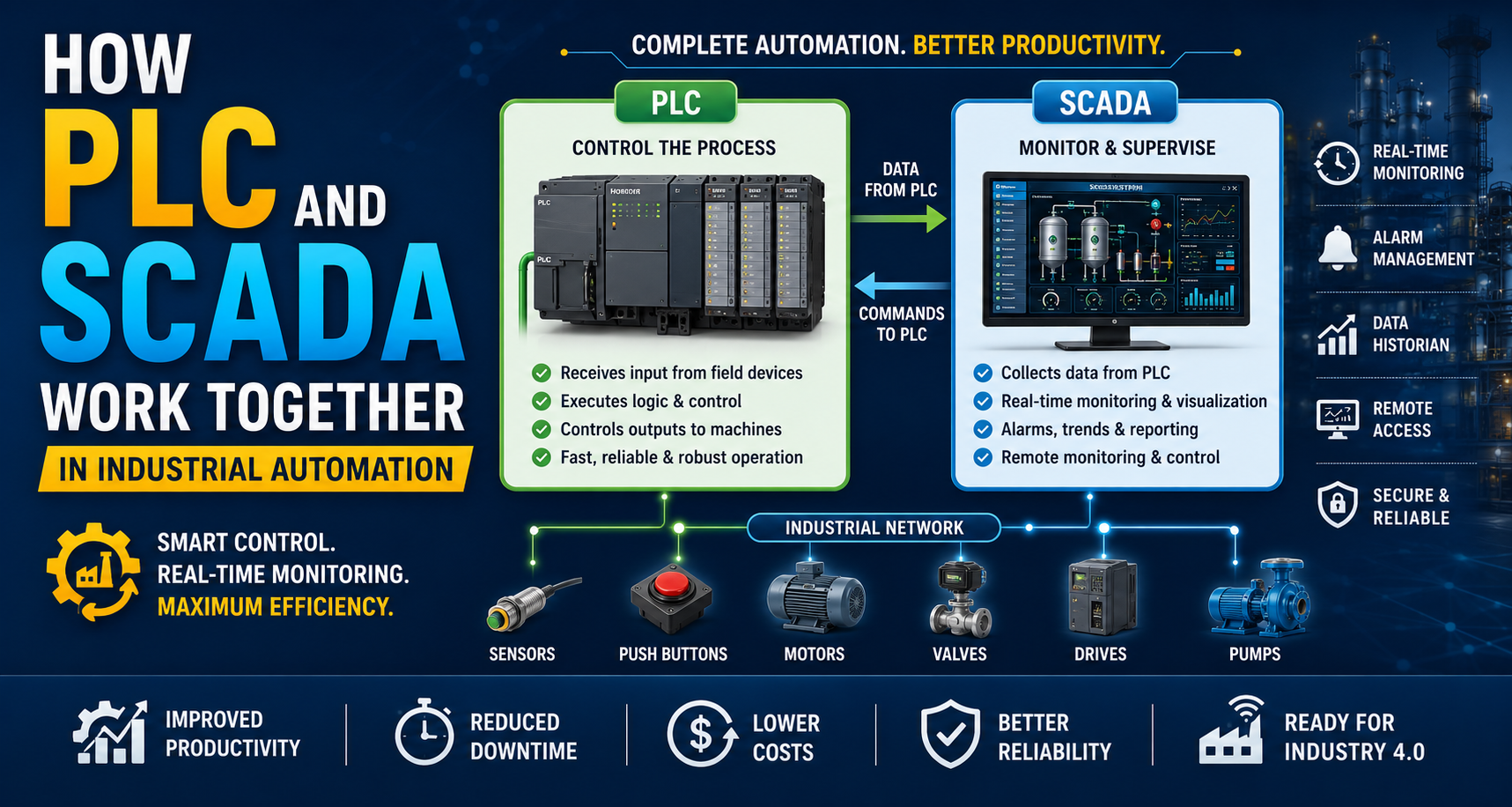
Modern industries depend heavily on automation systems to improve productivity, reduce downtime, and ensure reliable operations. Two of the most important technologies used in industrial automation are PLC (Programmable Logic Controller) and SCADA (Supervisory Control and Data Acquisition).
Although both systems serve different purposes, they work together to create a complete industrial automation solution.
From manufacturing plants and textile industries to pharmaceutical factories and water treatment systems, PLC and SCADA systems help industries achieve:
- Real-time monitoring
- Automatic machine control
- Alarm management
- Data collection
- Improved operational efficiency
In this guide, we will understand how PLC and SCADA work together in industrial automation and why they are essential for modern industries.
What is a PLC?
A PLC (Programmable Logic Controller) is an industrial computer used to control machines and industrial processes.
PLCs receive signals from field devices such as:
- Sensors
- Push buttons
- Limit switches
- Temperature transmitters
The PLC processes this information using programmed logic and controls outputs such as:
- Motors
- Solenoid valves
- Relays
- Pumps
- Industrial drives
PLCs are designed for:
- High reliability
- Fast processing
- Industrial environments
- Continuous operation
Popular PLC brands include:
- Siemens
- Allen-Bradley
- Delta
- Mitsubishi
- Schneider Electric
What is SCADA?
SCADA stands for Supervisory Control and Data Acquisition.
SCADA systems are used to:
- Monitor industrial processes
- Display real-time machine data
- Generate alarms
- Store historical data
- Control operations remotely
SCADA acts as the visualization and supervisory layer of industrial automation systems.
A SCADA system usually includes:
- SCADA software
- HMI screens
- Industrial computers
- Communication networks
- Data servers
Popular SCADA platforms include:
- WinCC
- FactoryTalk View
- Ignition
- Wonderware
- AVEVA
Difference Between PLC and SCADA
| PLC | SCADA |
|---|---|
| Controls machines and processes | Monitors and supervises processes |
| Executes logic operations | Displays real-time data |
| Works directly with field devices | Communicates with PLCs |
| Fast response time | Data visualization and reporting |
| Handles machine-level control | Handles plant-level monitoring |
In simple words:
- PLC = Brain of machine control
- SCADA = Eyes and monitoring system
How PLC and SCADA Work Together
PLC and SCADA systems communicate continuously to automate industrial processes efficiently.
Step 1: PLC Collects Field Data
PLCs receive input signals from:
- Sensors
- Switches
- Pressure transmitters
- Temperature devices
The PLC processes this information based on programmed logic.
Example:
If tank level becomes low:
- PLC starts water pump automatically
Step 2: PLC Controls Industrial Equipment
Based on logic conditions, PLC controls:
- Motors
- Pumps
- Valves
- Conveyors
- Industrial machinery
PLC decisions happen extremely fast for reliable machine operation.
Step 3: SCADA Reads Data from PLC
SCADA software communicates with PLC through industrial communication protocols such as:
- Profinet
- Modbus TCP
- Ethernet/IP
- OPC UA
SCADA reads:
- Machine status
- Motor condition
- Alarm data
- Process values
- Production information
Step 4: SCADA Displays Real-Time Information
SCADA provides operators with:
- Graphical process screens
- Real-time values
- Alarm notifications
- Trend charts
- System diagnostics
Operators can monitor the entire process from a central control room.
Step 5: Operator Sends Commands Through SCADA
Operators can:
- Start/stop machines
- Change setpoints
- Acknowledge alarms
- Monitor production remotely
SCADA sends commands to PLC, and PLC performs the control action.
Real Industrial Example
Water Treatment Plant
PLC Functions
- Monitor tank levels
- Start/stop pumps
- Control valves
- Maintain process sequence
SCADA Functions
- Display water levels
- Generate alarms
- Store production history
- Monitor entire plant remotely
Together, PLC and SCADA create a fully automated water treatment system.
Benefits of PLC and SCADA Integration
1. Real-Time Monitoring
SCADA allows operators to monitor entire production systems instantly.
2. Faster Troubleshooting
Alarm systems help engineers quickly identify machine faults.
3. Improved Productivity
Automation reduces manual intervention and improves production efficiency.
4. Better Data Collection
SCADA stores:
- Production data
- Alarm history
- Energy consumption
- Machine performance
This helps management make better decisions.
5. Remote Monitoring
Modern SCADA systems allow remote access through:
- Industrial networks
- Cloud systems
- Mobile devices
6. Reduced Downtime
PLC and SCADA systems quickly identify faults and reduce machine stoppages.
Communication Between PLC and SCADA
Industrial communication protocols are essential for integration.
Common protocols include:
- Modbus
- Profinet
- Ethernet/IP
- OPC UA
- Profibus
These protocols ensure reliable and fast data exchange between systems.
Role of HMI in PLC and SCADA Systems
HMI (Human Machine Interface) is often integrated between PLC and SCADA.
HMI provides:
- Local machine control
- Basic monitoring
- Operator interaction
SCADA provides:
- Plant-wide supervision
- Data logging
- Remote monitoring
Applications of PLC and SCADA Systems
PLC and SCADA are widely used in:
- Manufacturing plants
- Textile industries
- Pharmaceutical industries
- Food processing
- Packaging systems
- Water treatment plants
- Oil & gas industries
Common Challenges in PLC and SCADA Systems
Industries may face:
- Communication failures
- Network issues
- Slow SCADA performance
- PLC programming errors
- Sensor failures
Proper system design and maintenance help avoid these problems.
Future of PLC and SCADA in Industry 4.0
Modern industrial automation is moving toward:
- Smart factories
- Industrial IoT
- Cloud integration
- Predictive maintenance
- AI-based monitoring
PLC and SCADA systems are evolving to support:
- Real-time analytics
- Remote diagnostics
- Intelligent automation
- Cybersecurity
They remain the foundation of Industry 4.0.
Best Practices for Reliable PLC and SCADA Systems
Industries should:
- Use proper communication networks
- Maintain regular backups
- Optimize SCADA graphics
- Follow PLC programming standards
- Monitor alarm systems properly
- Implement cybersecurity measures
Conclusion
PLC and SCADA systems work together to create powerful and reliable industrial automation solutions.
PLCs handle:
- Real-time machine control
- Process logic
- Equipment operation
SCADA systems provide:
- Monitoring
- Visualization
- Alarm management
- Data collection
Together, they help industries achieve:
- Better productivity
- Reduced downtime
- Improved monitoring
- Faster troubleshooting
- Smart manufacturing capabilities
As industrial automation continues growing, PLC and SCADA integration will remain essential for modern factories and Industry 4.0 applications.
FAQs
1. What is the main difference between PLC and SCADA?
PLC controls machines and processes, while SCADA monitors and supervises industrial systems.
2. Can SCADA work without PLC?
SCADA usually depends on PLCs or other controllers to collect and control industrial data.
3. Which communication protocols are used between PLC and SCADA?
Common protocols include Modbus, Profinet, Ethernet/IP, OPC UA, and Profibus.
4. Why are PLC and SCADA important in industrial automation?
They improve monitoring, control, efficiency, troubleshooting, and production reliability.
5. Which industries use PLC and SCADA systems?
Manufacturing, textile, pharma, packaging, food processing, water treatment, and many other industries use these systems.