

Introduction
Modern software applications are expected to process real-time data, support millions of users, and respond instantly to system activities.
Traditional request-response architectures often struggle when applications become highly distributed and scalable.
To solve this challenge, many modern systems use Event-Driven Architecture (EDA).
Event-driven architecture allows applications to communicate asynchronously through events, enabling systems to become more scalable, flexible, and responsive.
Today, event-driven systems are widely used in:
- E-commerce platforms
- Banking systems
- Ride-sharing applications
- Real-time analytics systems
- Streaming platforms
Understanding event-driven architecture has become increasingly important for developers and IT professionals building modern distributed applications.
What is Event-Driven Architecture?
Event-Driven Architecture is a software design pattern where system components communicate through events.
An event represents a change in state or an action that occurs within a system.
Examples of events include:
- User registration
- Order placement
- Payment completion
- File upload
- Message received
Instead of services directly calling each other, events are produced and consumed asynchronously.
This reduces dependencies between systems and improves scalability.
How Event-Driven Architecture Works
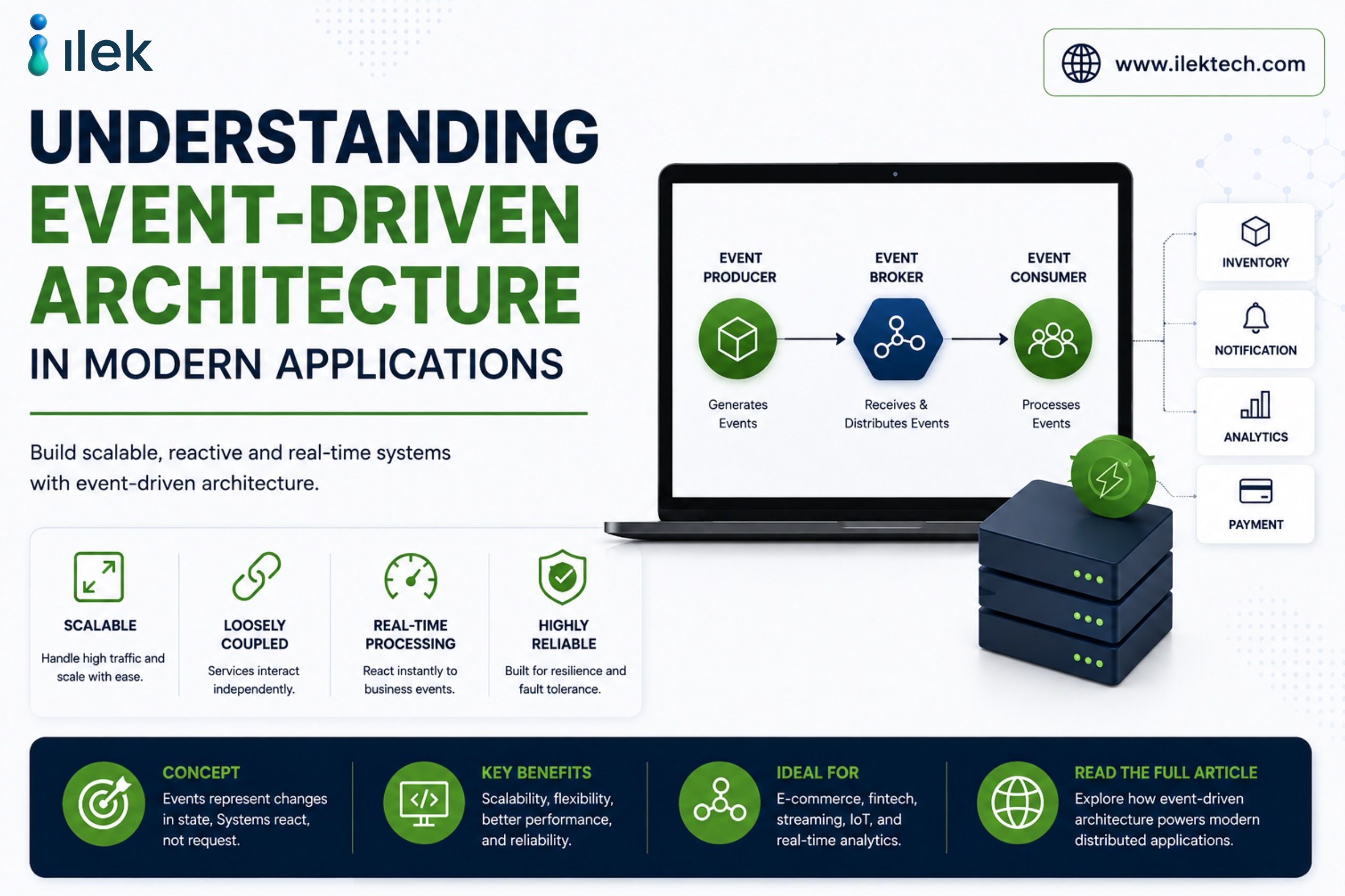
EDA typically consists of three main components.
1. Event Producer
The producer generates an event when an action occurs.
Example:
An e-commerce application creates an event after a customer places an order.
2. Event Broker
The event broker receives and distributes events to relevant services.
Popular event brokers include:
- Apache Kafka
- RabbitMQ
- Redis Streams
The broker acts as the communication layer between services.
3. Event Consumer
Consumers listen for events and perform specific actions.
For example:
- Inventory service updates stock
- Notification service sends emails
- Analytics service tracks activity
Multiple consumers can process the same event independently.
Benefits of Event-Driven Architecture
Scalability
Services can process events independently, making systems easier to scale.
Loose Coupling
Components do not need direct knowledge of each other.
This improves flexibility and maintainability.
Faster System Response
Events can be processed asynchronously, improving application performance.
Better Reliability
Failures in one service do not necessarily impact the entire system.
Event-Driven Architecture vs Traditional Architecture
| Feature | Traditional Systems | Event-Driven Systems |
| Communication | Synchronous | Asynchronous |
| Scalability | Moderate | High |
| Coupling | Tight | Loose |
| Flexibility | Limited | High |
This is why event-driven systems are commonly used in modern scalable applications.
Real-World Use Cases
E-commerce Platforms
When an order is placed:
- Payment service processes payment
- Inventory service updates stock
- Notification service sends confirmation
All actions happen independently through events.
Banking Systems
Banks use event-driven systems for:
- Fraud detection
- Real-time transaction processing
- Account notifications
Streaming Platforms
Streaming applications process millions of real-time events continuously.
Relationship with Microservices
Event-driven systems work extremely well with microservices architecture for scalable applications.
Microservices can communicate asynchronously using events instead of direct API calls.
This improves system flexibility and resilience.
APIs vs Events
Many developers confuse APIs with events.
APIs
- Request-response communication
- Synchronous interaction
- Immediate response expected
Events
- Asynchronous communication
- Services react independently
- No immediate response required
Modern applications often combine both approaches.
This also complements API-first development, where APIs are designed carefully for external communication while events manage internal workflows.
Challenges of Event-Driven Systems
Despite its advantages, EDA introduces complexities.
Debugging Complexity
Tracking events across distributed systems can be difficult.
Event Ordering Issues
Events may arrive out of sequence.
Data Consistency
Maintaining consistency across services requires careful design.
Monitoring Requirements
Organizations need advanced monitoring and observability tools.
Future of Event-Driven Applications
As applications become more distributed and real-time, event-driven architecture will continue growing.
In the future, we can expect:
- More real-time applications
- Increased adoption of Kafka and streaming systems
- Smarter distributed architectures
- Better observability platforms
EDA is becoming a key foundation for scalable software systems.
Conclusion
Event-driven architecture is transforming how modern applications communicate and scale.
By enabling asynchronous communication between services, organizations can build systems that are more flexible, scalable, and resilient.
For developers and IT professionals, understanding event-driven principles is essential for building modern distributed applications.