

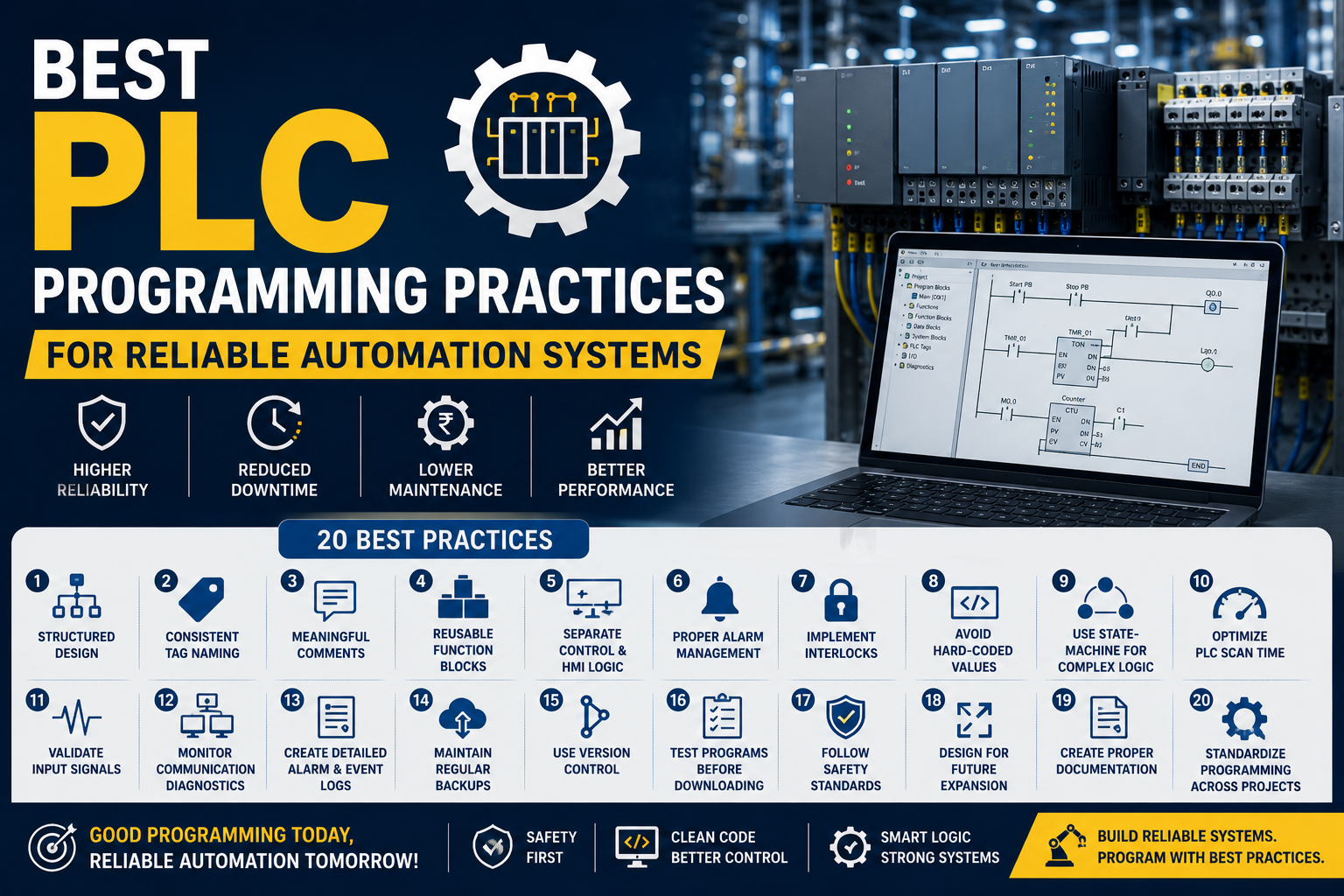
Best PLC Programming Practices for Reliable Automation Systems
Introduction
Programmable Logic Controllers (PLCs) are the foundation of modern industrial automation systems. Well-structured PLC programming improves reliability, maintainability, safety, and productivity.
Why PLC Programming Standards Matter
Programming standards help reduce downtime, simplify troubleshooting, improve documentation, and support future upgrades.
Best Practices
1. Use structured program design.
2. Follow consistent tag naming conventions.
3. Add meaningful comments.
4. Create reusable function blocks.
5. Separate control logic from HMI logic.
6. Implement proper alarm management.
7. Use interlocks for safe operation.
8. Avoid hard-coded values.
9. Use state-machine programming for complex machines.
10. Optimize PLC scan time.
11. Validate input signals.
12. Monitor communication diagnostics.
13. Create detailed alarm and event logs.
14. Maintain regular backups.
15. Use version control.
16. Test programs before downloading.
17. Follow safety standards.
18. Design for future expansion.
19. Create proper documentation.
20. Standardize programming across projects.
Conclusion
Reliable PLC programming ensures stable machine operation, faster troubleshooting, lower maintenance costs, and long-term system performance.