

Introduction
The world of software development is evolving faster than ever before. With the rise of Artificial Intelligence (AI), the way developers write code, test applications, and deliver solutions has fundamentally changed. What once required hours of manual effort can now be achieved in minutes with the assistance of intelligent tools.
AI is no longer just a futuristic concept—it is now an essential part of modern development workflows. Businesses that adopt AI-driven development are gaining a competitive advantage, while developers who embrace AI are becoming more efficient, productive, and innovative.
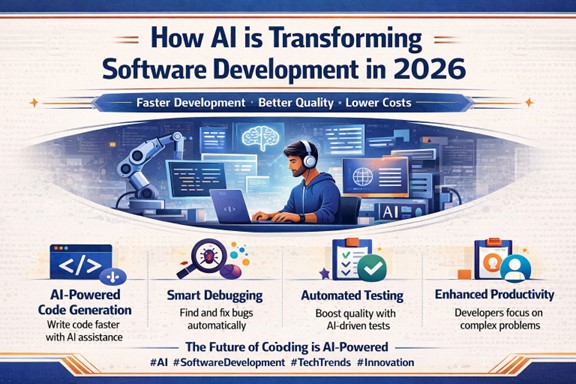
1. AI-Powered Code Generation
One of the most significant transformations AI has brought is in code generation. Developers can now use AI tools to write boilerplate code, generate functions, and even build entire modules with minimal input.
Instead of writing repetitive code, developers can focus on solving complex problems and designing better architectures. This not only speeds up development but also reduces human error.
Impact:
- Faster development cycles
- Reduced manual coding effort
- Improved productivity
2. Smarter Debugging and Error Detection
Debugging has always been a time-consuming part of software development. AI tools can now automatically detect bugs, suggest fixes, and even predict potential issues before they occur.
By analyzing patterns in code, AI can identify vulnerabilities and performance bottlenecks much earlier in the development process.
Impact:
- Reduced debugging time
- Higher code quality
- Early detection of issues
3. Automated Testing and Quality Assurance
Testing is critical, but it often consumes a large portion of development time. AI is revolutionizing this process by automating test case generation, execution, and analysis.
AI can simulate user behavior, generate edge cases, and ensure that applications perform well under different conditions.
Impact:
- Faster testing cycles
- Better test coverage
- Improved software reliability
4. Enhanced Developer Productivity
AI acts as a smart assistant for developers. It helps with code suggestions, documentation, and even learning new technologies.
Developers no longer need to search extensively for solutions—AI provides instant answers and recommendations.
Impact:
- Increased efficiency
- Faster learning curve
- Reduced development stress
5. Intelligent Project Management
AI is not just limited to coding—it is also transforming project management. It can predict timelines, allocate resources, and identify risks based on historical data.
This leads to better planning and smoother execution of projects.
Impact:
- Improved project planning
- Better resource utilization
- Reduced project delays
6. Personalized User Experiences
AI enables developers to build applications that understand user behavior and adapt accordingly. From recommendation systems to chatbots, AI helps create highly personalized user experiences.
This is especially valuable for businesses looking to increase customer engagement and retention.
Impact:
- Better user engagement
- Increased customer satisfaction
- Higher conversion rates
7. Cost Reduction for Businesses
By automating repetitive tasks and improving efficiency, AI significantly reduces development costs. Companies can deliver projects faster with smaller teams while maintaining high quality.
This makes AI adoption a strategic investment rather than an expense.
Impact:
- Lower operational costs
- Faster time-to-market
- Higher return on investment
Challenges of AI in Software Development
While AI offers numerous advantages, it also comes with challenges:
- Over-reliance on AI tools
- Need for skilled professionals to manage AI systems
- Data privacy and security concerns
Businesses and developers must strike a balance between automation and human expertise.
The Future of AI in Development
The future of software development is a collaboration between humans and AI. Developers will not be replaced by AI—instead, they will be empowered by it.
We can expect:
- Fully automated development pipelines
- AI-driven architecture design
- More intelligent and self-learning applications
Conclusion
AI is transforming software development from a manual, time-intensive process into a faster, smarter, and more efficient system. It empowers developers to focus on innovation while automating routine tasks.
For businesses, adopting AI means staying ahead in a competitive market. For developers, it means unlocking new levels of productivity and creativity.
The question is no longer whether to adopt AI—but how quickly you can embrace it.
Final Thought
Organizations and developers who adapt to AI today will lead the technology landscape tomorrow. The future belongs to those who innovate, automate, and evolve.