

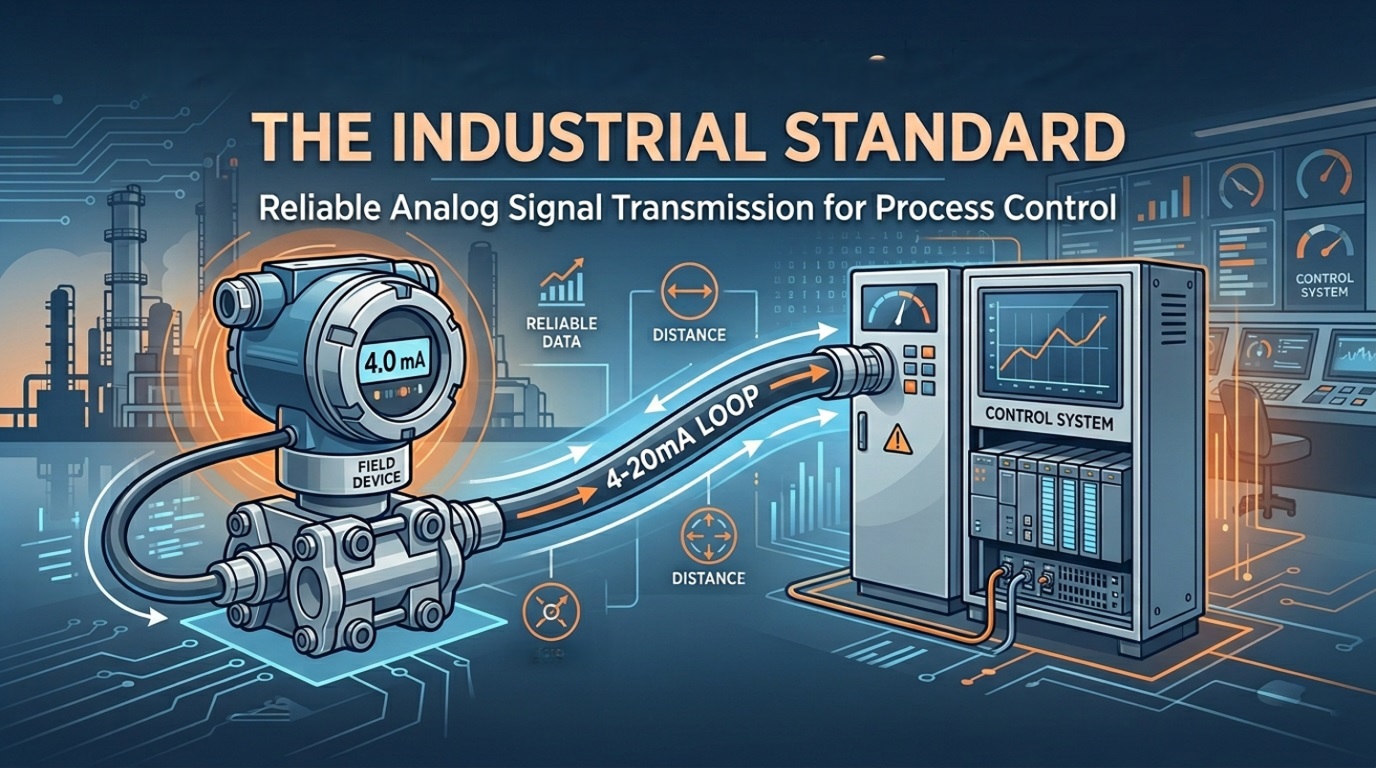
Walk into any industrial facility - a chemical plant, water treatment facility, or manufacturing line - and you will find sensors measuring pressure, temperature, flow, and level. But here is the question: how does a sensor 500 meters away from the control room send accurate data without losing signal quality?
The answer is the 4-20mA current loop - a brilliant, decades-old standard that remains the backbone of industrial instrumentation today.
In this guide, we will break down what 4-20mA signals are, why they dominate industrial automation, how they work, and when to use them.
What is a 4-20mA Signal?
A 4-20mA signal is an analog current loop standard used to transmit sensor measurements over long distances. Instead of varying voltage (which degrades over distance), the signal varies current between 4 milliamperes (mA) and 20 milliamperes (mA).
The Key Numbers:
- 4mA = 0% of measurement range (minimum value)
- 20mA = 100% of measurement range (maximum value)
- 12mA = 50% of measurement range (midpoint)
Simple Example:
Imagine a pressure sensor measuring 0 to 100 PSI:
- 0 PSI (0%) → Sensor outputs 4mA
- 50 PSI (50%) → Sensor outputs 12mA
- 100 PSI (100%) → Sensor outputs 20mA
- 75 PSI (75%) → Sensor outputs 16mA
Why is 4-20mA Used? (Not 0-20mA or Voltage?)
The 4-20mA standard was developed in the 1950s-60s and has survived because it solves critical problems that voltage-based signals cannot. Here is why it is still the gold standard:
1. Immunity to Voltage Drops and Noise
Voltage signals degrade over long cable runs due to resistance. A 10V signal sent 500 meters away might arrive as 9.2V, causing measurement errors.
Current loops are immune to this problem. Since current is the same at every point in a series circuit, the 12mA signal sent from the sensor arrives as exactly 12mA at the PLC - even if the cable is 1 kilometer long.
Electrical noise (from motors, VFDs, welding equipment) affects voltage signals but has minimal impact on current signals.
2. Live Zero Detection (Why 4mA, Not 0mA?)
The genius of starting at 4mA instead of 0mA is fault detection:
- 0mA = Wire break or sensor failure (fault condition)
- 4mA = Valid signal at minimum measurement (0% scale)
- Below 3.5mA = Fault alarm triggered automatically
This is called a "live zero." If the sensor wire breaks or the transmitter fails, the current drops to 0mA, and the control system immediately knows there is a problem - not just a low reading.
3. Two-Wire Design Simplicity
Most 4-20mA transmitters use a two-wire configuration where the same pair of wires provides both power to the sensor and carries the signal back. This reduces installation cost and wiring complexity.
Typical wiring: (+24VDC power supply) → Transmitter → (4-20mA signal) → PLC analog input → (-24VDC return)
4. Standardization Across All Industries
4-20mA is universally accepted. Whether you are in oil & gas, water treatment, pharmaceuticals, food processing, or power generation, the standard is the same. This means:
- Any sensor can work with any PLC or DCS
- Replacement parts are widely available
- Technicians across industries understand it
- Minimal training required for maintenance staff
Advantages of 4-20mA Signals
- Long-distance transmission: Works reliably over 1000+ meters
- Noise immunity: Current signals resist electrical interference
- Simple wiring: Two wires for both power and signal
- Fault detection: 0mA indicates wire break or transmitter failure
- Universal compatibility: Works with any brand of PLC, DCS, or recorder
- Accurate and stable: Minimal signal drift over time and temperature
- Loop-powered transmitters: No separate power cables needed for many devices
- Easy troubleshooting: Use a simple multimeter to measure current anywhere in the loop
4-20mA vs Other Analog Signals
| Signal Type | Advantages | Disadvantages | Typical Use |
|---|---|---|---|
| 4-20mA | Noise immune, long distance, fault detection | Slow, one variable per wire | Process control, field instruments |
| 0-10V | Fast response, simple | Voltage drop over distance, no fault detection | Short distances, panel sensors |
| 0-5V / 1-5V | Lower power consumption | Same as 0-10V but less noise margin | Building automation, HVAC |
| Thermocouple | Direct temperature sensing, rugged | Requires compensation, low voltage | High-temperature measurement |
| RTD | Accurate, stable | More expensive, requires current source | Precision temperature sensing |
Conclusion
The 4-20mA current loop is a testament to brilliant engineering design that has stood the test of time. Despite being developed over 60 years ago, it remains the dominant standard in industrial instrumentation because it solves real-world problems effectively:
- Immunity to electrical noise and voltage drops
- Built-in fault detection with live zero
- Simple two-wire installation
- Universal compatibility across all industries
- Reliable operation over long distances